Advanced stabilization strategies offer long-term performance and cost savings
By TOM RIMMINGTON
Unsealed roads can be a persistent source of dust. Particles become airborne from vehicle traffic and wind exposure, and aerodynamic forces disperse those particles into the atmosphere, accelerating the degradation of the road surface and increasing the need for costly maintenance to preserve safe road conditions.
The issues with unsealed roads extend beyond the wear and tear of the surface. Dust can reduce visibility for road users, creating issues for driver safety, and it can cause problems by migrating into the surrounding environment and communities. That makes an effective dust management plan a practical solution for road surface stability.
Traditional methods for managing dust can provide short-term relief, but they must be reapplied frequently and are resource- and labor-intensive. Field research demonstrates that acrylate polymer-based stabilization solutions can more effectively reduce dust and maintain performance under traffic and rainfall conditions when integrated into the road surface, supporting operational efficiencies and reducing maintenance and resource requirements.
Longer-Term Solutions
Traditional dust suppression practices have largely relied on short-term methods such as water carting—transporting tanks of water to use in spraying down road surfaces. While water can offer an immediate reduction in airborne dust emissions, its effects are short-lived. Water carting is also inherently resource- and labor-intensive, producing higher long-term costs for the use of water, labor, fuel, and other
resources. As a result, there is increasing interest in approaches that provide longer-term dust control.
The transition toward longer-term dust suppression is supported by independent field research. In a controlled field trial, Australia-based Strategic Environmental and Engineering Consulting (SEEC) assessed dust generation on unsealed roads under real-world conditions at a site in New South Wales (NSW).
SEEC measured dust using AS/NZS 3580.1-compliant dust deposition gauges over almost 20 weeks to measure the performance of short- and long-term dust-control measures. The trial was conducted under variable environmental conditions, which included rainfall of 553.2 mm (21.8 in) during the monitoring period.
The results demonstrated significant dust reduction in the early weeks following application, particularly on formed-earth road surfaces with fine particles ready for stabilization. Over longer periods, differences in performance were influenced by both the construction material and the method of application.
At a gravel road site, a blended application method that incorporated a stabilizing agent into the surface during grading and compaction achieved approximately a 30% improvement in mitigating dust erosion compared to untreated and surface-level treated sections.
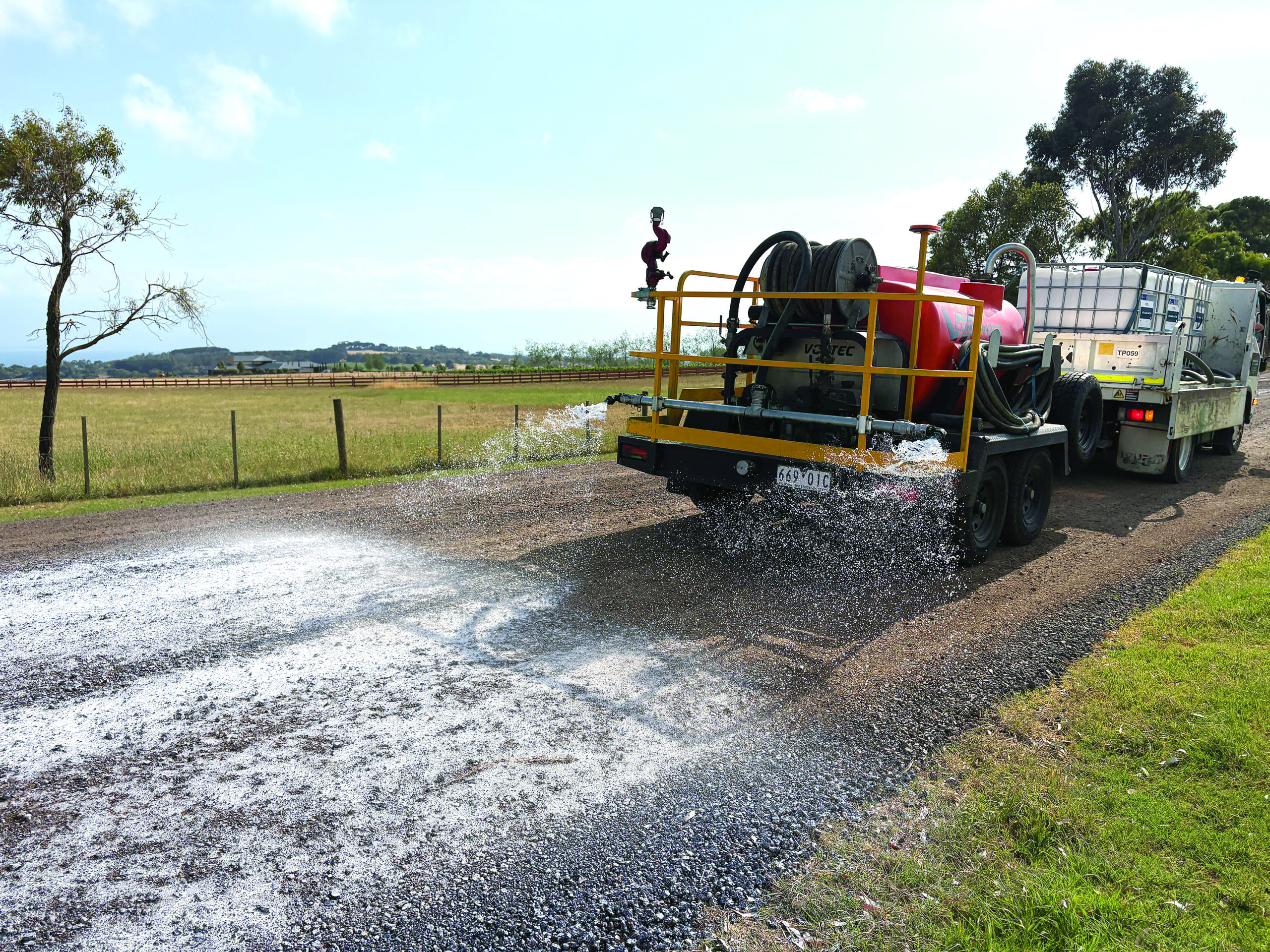
Supplied as a concentrated liquid formulation, the polymer was diluted with water to a controlled application rate of 1 l (33.8 oz) per m2 (1.2 yd2) of surface area. The solution was applied using a calibrated application truck; a pneumatic roller followed to incorporate the soil binder into the road material to maximize bonding effectiveness. No additional maintenance was performed on any of the trial sections during the monitoring period, offering an indication of the durability of treatments under typical operating conditions, including exposure to rainfall and traffic. The presence of significant rainfall throughout the trial further demonstrates the importance of a dust-control method that maintains surface integrity under wet conditions and continues to perform in wet and dry environments.
Binding Fine Particles
These findings highlight a key principle in dust suppression: Long-term performance is linked closely to the binding capabilities of the treatment and its interaction with the road surface. Applications that bind fine particles in the road matrix and reduce permeability proved more resistant to environmental exposure, delivering improved durability and more consistent outcomes over time.
Polymer-based stabilization technologies have been developed to address these performance requirements. Water-based acrylate polymer products are designed to bind fine particles within the surface layer, forming a strong, flexible bond that reduces the risk of particle mobilization under traffic.
Where the application is integrated into the surface profile, treatment can also assist in reducing sediment erosion during rainfall events. The polymer requires four to six hours to cure following application; sufficient allowance should be made for site-specific conditions and any forecast rain or wind events. Once cured, the product forms a stable veneer over the road surface that does not remobilize under normal operating conditions, allowing the treatment to maintain performance under traffic and environmental exposure.
Real-World Performance
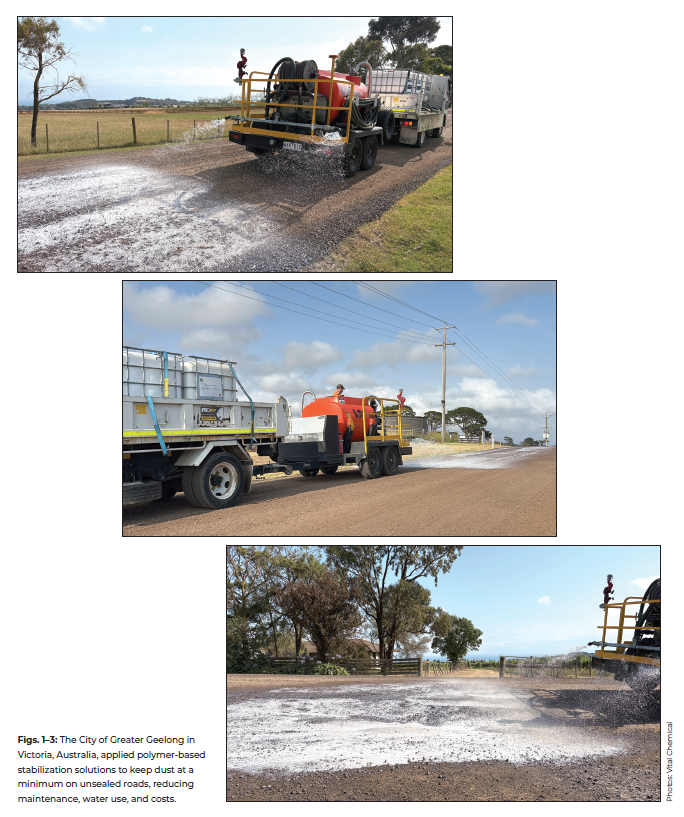
The City of Greater Geelong’s dust suppression program in Victoria’s Bellarine Peninsula shows how the practical application of polymer-based dust management programs can benefit residents. Treating about 150,000 m2 (179,000 yd2) of unsealed roads, the program incorporated a polymer stabilization technology into standard maintenance practices including grading, moisture conditioning, and compaction—the same underlying approach as the SEEC trials in an operational environment.
Since application on Feb. 6, 2026, crews haven’t needed to return to any of the treated roads—a clear improvement upon historical maintenance patterns, where roads typically required up to four treatments per year, depending on seasonal conditions. Application of the water-based polymer dust suppression solution has so far eliminated the need for reapplication.
The program delivered immediate, measurable cost savings to civil construction projects. Based on an average cost of AUD$4,361 per road maintenance visit, the reduction of a single revisit across the network of four high-frequency roads generates a savings of more than AUD$17,000. This figure excludes plant mobilization and indirect costs, meaning the actual savings is likely higher. Across the broader network, the cost reduction on maintenance is estimated to be more than AUD$260,000 per year.
Benefiting Communities
Community outcomes further reflect the benefits of the program. Prior to application, Geelong’s road network generated approximately three dust-related complaints per week. In the first four months following application, the city council didn’t receive a single complaint—a 100% reduction in dust-related complaints that alleviated community friction and administrative workloads.
While the SEEC trial and the Geelong program differ in scale and context, they provide similar insights. Advanced stabilization approaches can reduce dust and maintain performance under variable environmental conditions, and network-scale application highlights the practical benefits in terms of reduced maintenance demand, lower resource use, and improved outcomes for local communities and the environment. These outcomes underscore the importance of aligning a practical dust management program with any project’s long-term performance and environmental stewardship objectives. The evolution of dust suppression solutions toward polymer-based, environmentally sound stabilization technologies reflects a broader shift toward the long-term, resource-efficient management of unsealed roads. By reducing the frequency of intervention and limiting reliance on water and labor-intensive practices, these approaches can help lower operational demands while delivering more consistent outcomes.
About the Expert
Tom Rimmington is commercial manager for Vital Chemical, an industry leader in erosion control, dust suppression, revegetation, and water treatment solutions based in Queensland, Australia. He serves on IECA Australasia’s Young Professionals Committee.
Notes
1 Joint Australian and New Zealand Standards for ambient air quality.