Start stormwater management at the
beginning of a solar project to prevent erosion
Stormwater and erosion control are significant considerations for infrastructure development projects, and large acreages are now being converted to utility-scale solar farms as energy demand increases. On solar projects where the previous land use is not perennial grassland such as row-crop agriculture or forestry, strategic planning for stormwater management is critical due to large areas of bare ground.
By implementing innovative science and agricultural-based techniques, not only will stormwater design be more successful, but overall costs will be lower due to fewer failures and expedited permit closure.
Limited Access
Unlike linear or underground projects, where restoration can be performed effectively after project completion, solar restoration poses a challenge due to limited equipment access in and around panels. By rearranging the traditional project timeline and starting restoration at the beginning of a project, stormwater risk can be lowered significantly.
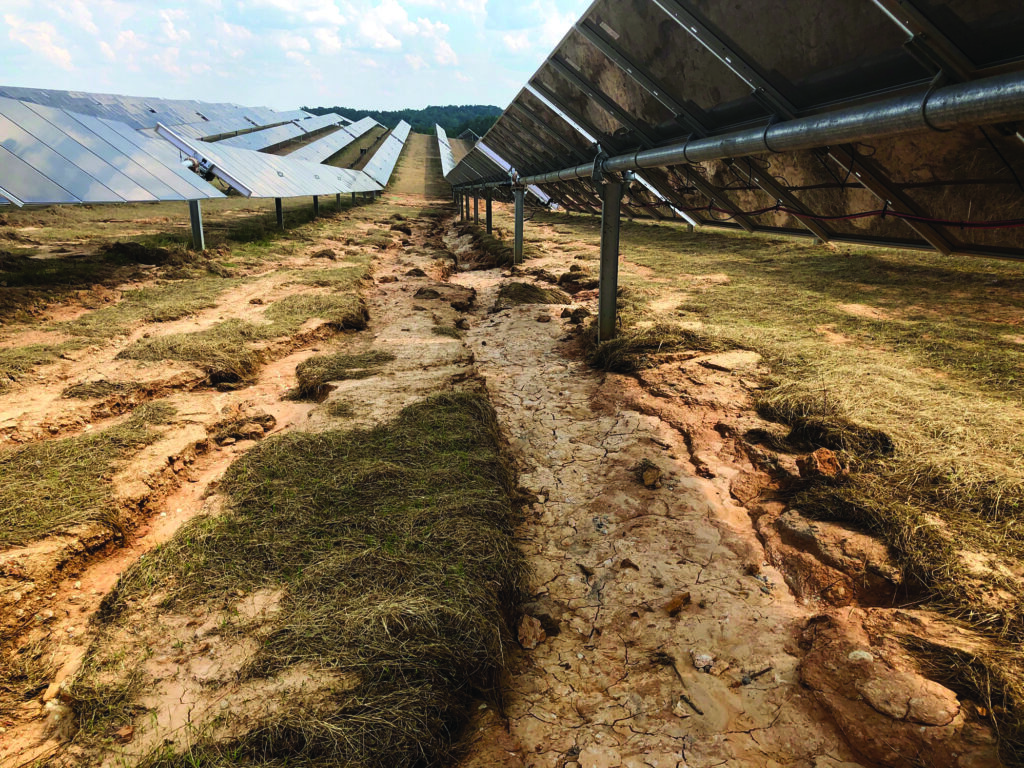
Traditional sediment and erosion control plans rely heavily on temporary and perimeter controls to manage erosion and prevent off-site deposition. This can be effective on smaller drainage areas, but utility-scale solar sites often span hundreds of acres. It isn’t practical or effective to have controls break up the landscape and inhibit equipment traffic. This also exposes large areas of ground and offers stormwater longer distances to travel, channelize, and cause erosion (Figs. 1-2).
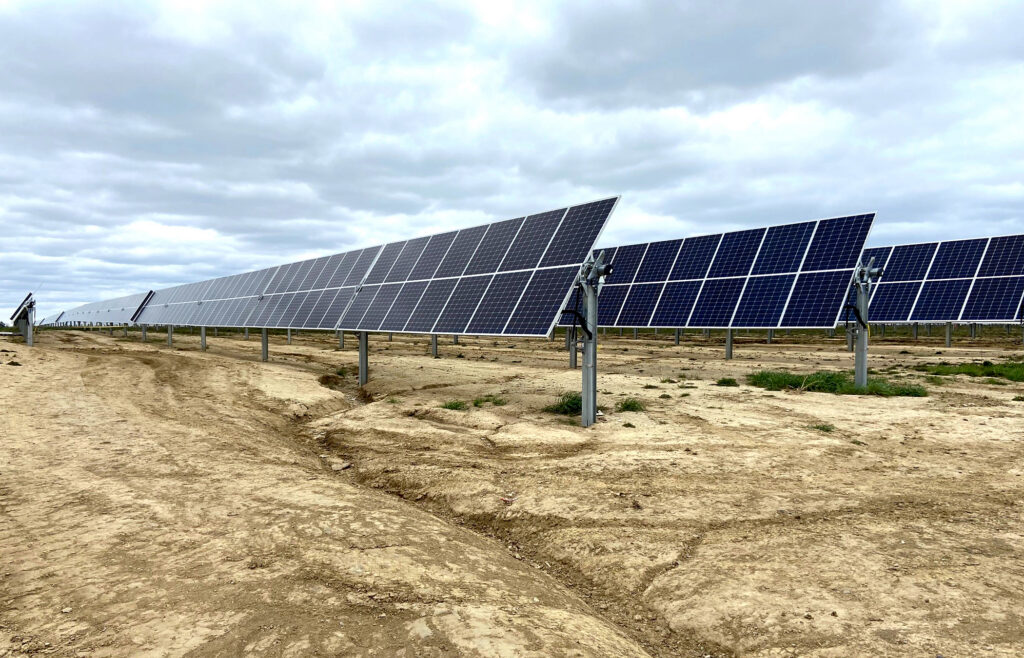
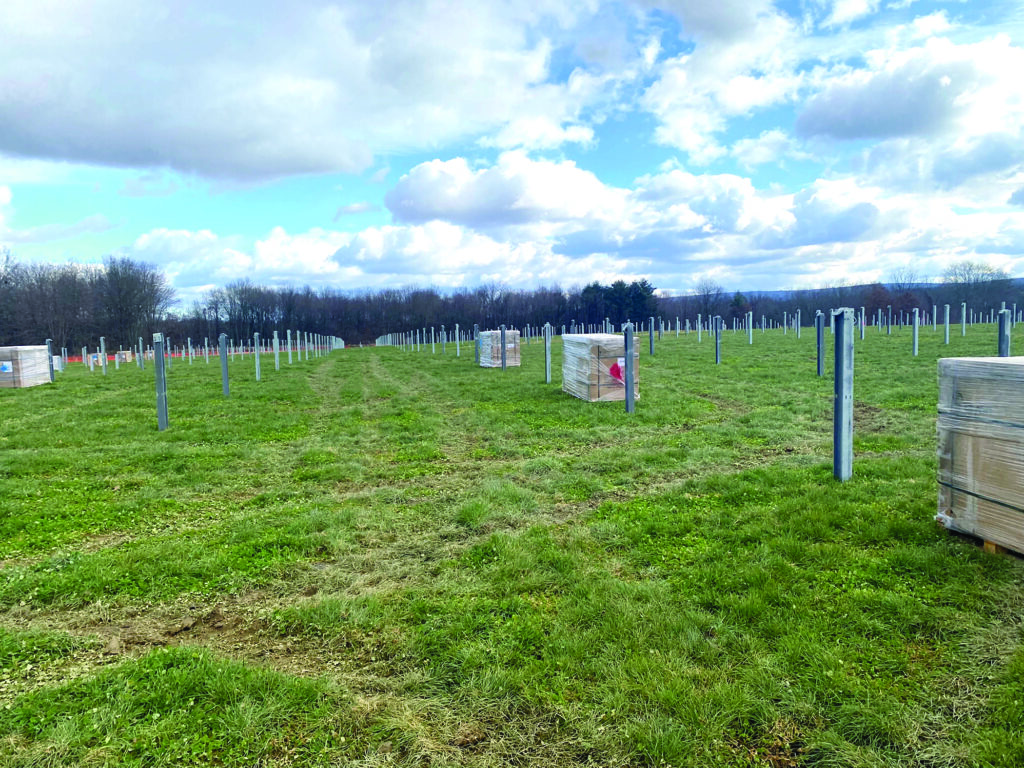
The implementation of restoration as part of the civil phase of construction allows vegetation to establish concurrently with construction (Fig. 3). Not only does this reduce the restoration scope at the end of the project, it also lessens the total erosion potential during the construction phase significantly. As vegetation grows and covers the soil surface, the erosion potential or “R-factor” decreases.
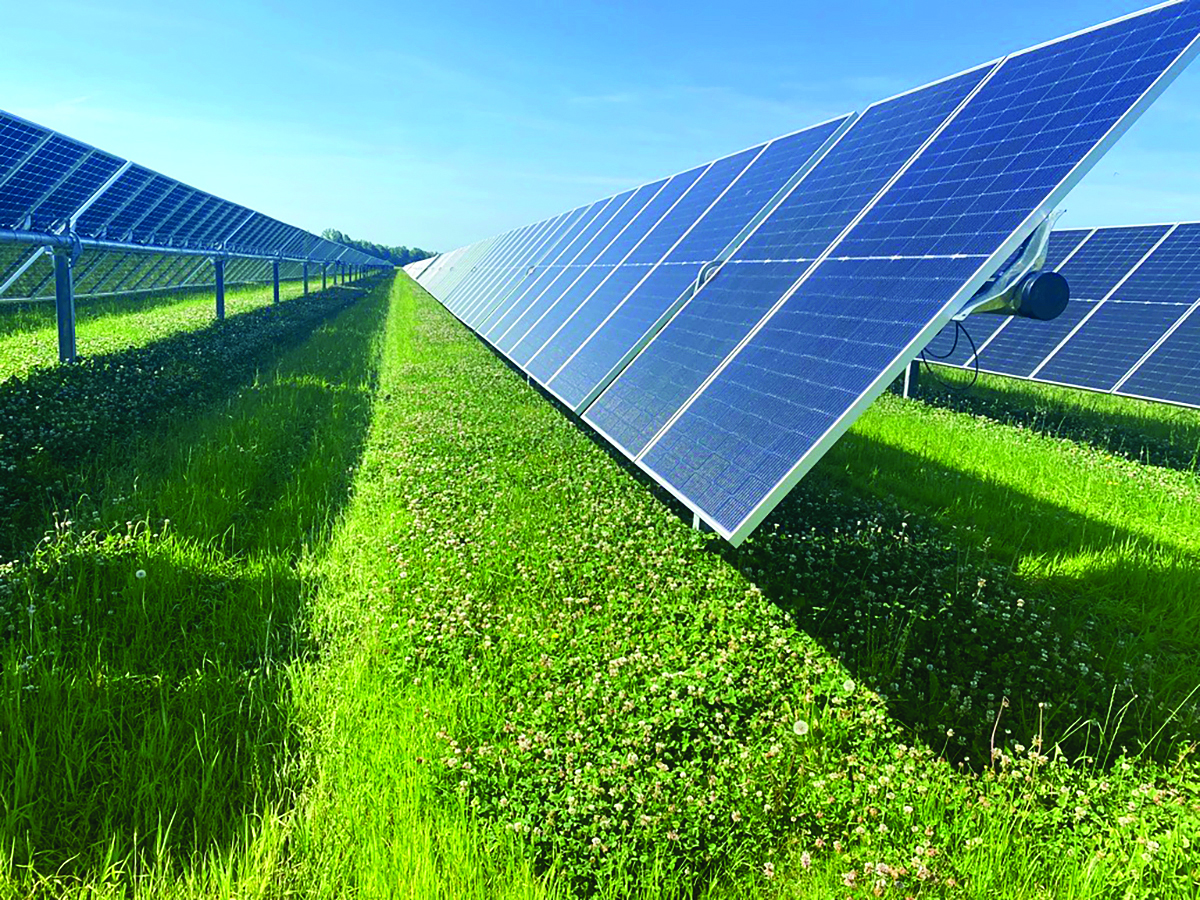
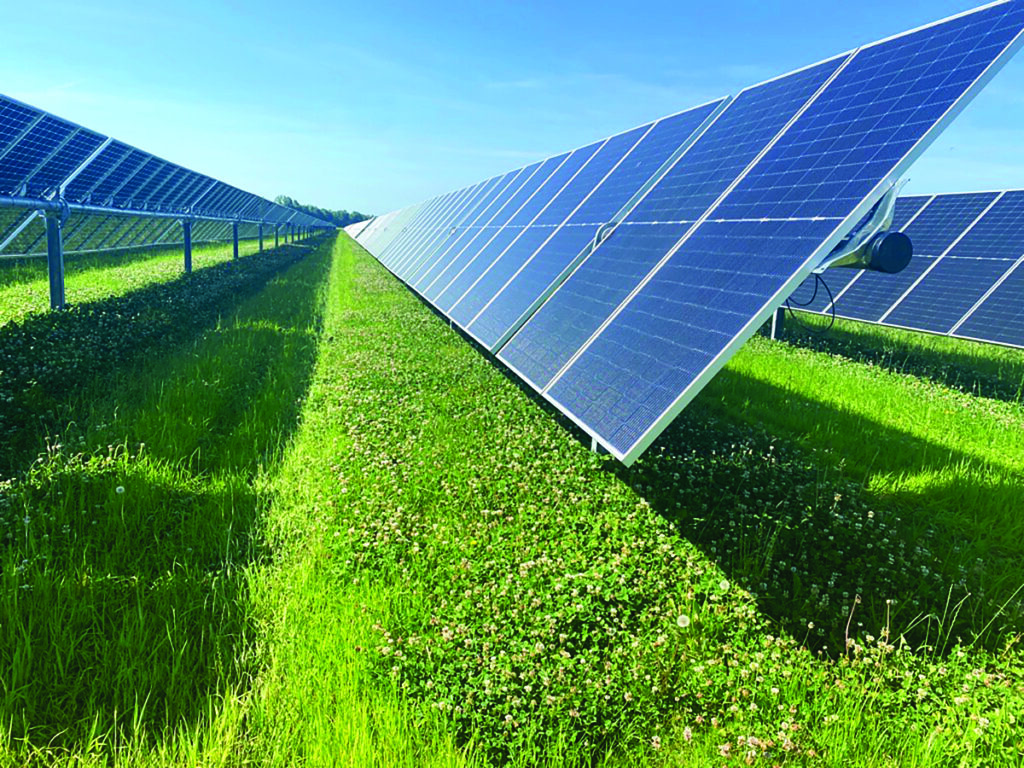
The R-factor and other characteristics, such as surface roughness, slope, and soil type, are important considerations for determining a project’s erosion control and stormwater basin design. In instances where minimal grading is needed for tracker design, a solar site can be fully seeded prior to construction. If a site is fully vegetated (Fig. 4), the footprint of—or the need for—temporary controls such as basins can be reduced. Additionally, both growing and established vegetation reduce total erosion, minimizing maintenance burdens during construction.
The presence of established vegetation on a site contributes to the following:
- Reduced soil erosion from raindrop impact. The force raindrops exert when they hit the ground results in small particles of soil becoming dislodged and carried off in sheet flow.
- Improved infiltration into the soil through root channels, resulting in less runoff.
- Reduced occurrence of surface sealing, when clay particles disperse on the surface and prevent infiltration.
- Improved soil drying and surface working conditions through plant evapotranspiration.
- Reduced soil compaction and surface rutting due to root systems reestablishing soil aggregation and structure.
Find the Right Mix
Implementing restoration before construction or at its start—sometimes referred to as preconstruction seeding or preseeding—requires planning. Knowledgeable professionals such as soil scientists and restoration experts can tailor a seed mix to a site to achieve the greatest benefit.
Alongside a suitable seed mix that contains annual and perennial species, a strategic seeding plan must be developed alongside the site’s civil grading plan. Coordinating civil work, time of year, and construction milestone dates with seeding work optimizes establishment.
In order for a site to use vegetation as a primary method of erosion control, soil management must be a priority. A seed mix alone can’t overcome poor soil quality, compaction, unsuitable soil chemistry, or lack of topsoil. Mismanagement of soil is problematic when trying to establish vegetation at any point in the project timeline and particularly at the end of a project, when attempting to file for a Notice of Termination for the Construction General Permit.
Implementing restoration upfront tends to reduce the total acreage of land needing to be permanently stabilized with vegetation, in addition to decreasing overall erosion during construction. Seeding and restoration work after module installation is costly due to the need for small equipment and tractors, the increased risk of damaging solar infrastructure, and low production rates (acres seeded per day).
Additionally, seeding under solar modules is difficult and often ineffective. Early seeding work allows vegetation to become established in areas that will be difficult to access later, saving time and allowing restoration work to be concentrated in more accessible areas with faster production rates. Depending on when construction is completed on projects where reseeding is limited to access and disturbed areas rather than the whole site, stormwater permits may be able to be closed out within months of final seeding.
Additional benefits to implementing seeding and restoration activities at the start of solar construction include:
- Reduced weed pressure during site operations. Establishing a mix of annual and perennial grasses as soon as possible crowds out weeds instead of allowing weeds to germinate on exposed soil.
- Reduced occurrence of potential erosion warranty claims and pile scour. Soil is vulnerable to erosion after grading; vegetation holds the soil and prevents channels from forming. Erosion features are difficult and expensive to fix after module installation.
- Improved public perception during construction.
Innovative stormwater techniques don’t need to be complicated to be effective. Looking at the big picture, adapting practices from other industries, and rearranging the traditional timeline are all that is required. Proactively preventing erosion should be at the forefront of the strategy.
Vegetation can be used as a primary erosion control on solar farm sites while helping meet requirements for final site stabilization. Soil management and early seeding result in overall reduced erosion, shorter permit timelines, and less rework on a site. n
About the Expert
Virginia K. Brown is a licensed soil scientist who has worked in the construction industry for over 15 years, primarily in oil and gas, renewables, and transmission. Her expertise spans the life cycle of a project, from initial environmental permitting and studies, to civil design and construction stormwater management, to final restoration.