Electrical flocculation offers a promising enhancement to conventional practices
By Grace K. Kerr, Megan A. Sharpe, Barry Fagan, and Michael A. Perez
Detention-based sediment control practices—primarily sediment basins—hold runoff and promote the gravitational settling of coarse particles. Some silts and clays are too fine to settle within typical detention periods, however, limiting a detention-based practice’s ability to reduce turbidity.1,2,3
When properly applied, chemical flocculants can be used with stormwater runoff to accelerate settling of suspended sediments, but their performance is sensitive to soil matching and dosing control. Furthermore, many states do not allow the use of chemical flocculants due to downstream ecological concerns.2
Electrical flocculation provides an alternative treatment approach by generating reactive ions through a controlled electrical process. Ions hydrolyze to form hydroxide species, including low-charge forms that promote charge neutralization and aggregation of suspended particles without the addition of bulk chemicals.
How Electrical Flocculation Works
When direct current is applied to electrodes (commonly aluminum plates or rods), anodic dissolution releases dissolved aluminum (Al3+), while cathodic reactions produce hydroxide (OH-) and hydrogen gas (H2). Hydrolysis and precipitation produce a neutrally charged aluminum hydroxide (Al(OH)3), which promotes aggregation and subsequent settling.4
Electrical flocculation performance is governed by water chemistry (e.g., pH, conductivity) and reactor design (current density, electrode configuration, electrode spacing, mixing intensity, passivation).5,6
Led by a team of engineers and researchers from Fagan Consulting and Auburn University, the study described here advances the development of a portable electrical flocculation device, or Electric Floc Generator, and evaluates a self-sustained, floating application, the SOLO Floc Generator (SOLO). This work builds on research previously described in the January 2025 Environmental Connection and extends those efforts by evaluating an additional application of the in-basin SOLO Floc Generator.
The SOLO Floc Generator is designed to accelerate treatment of captured stormwater in a detention practice such as a sediment basin. In laboratory settings, the device has demonstrated exceptional removal of copper (100%), turbidity (98%), total suspended solids (90%), lead (82%), iron (73%), phosphorus (68%), and cadmium (60%). It also demonstrated modest levels of removal for zinc (33%).
Testing Electrical Flocculation
Recent experiments focused on deploying the SOLO configuration within a 2,790 ft3
(79.0 m3) sediment basin at the Auburn University Stormwater Research Facility
to assess turbidity reduction in a large-scale testing environment.
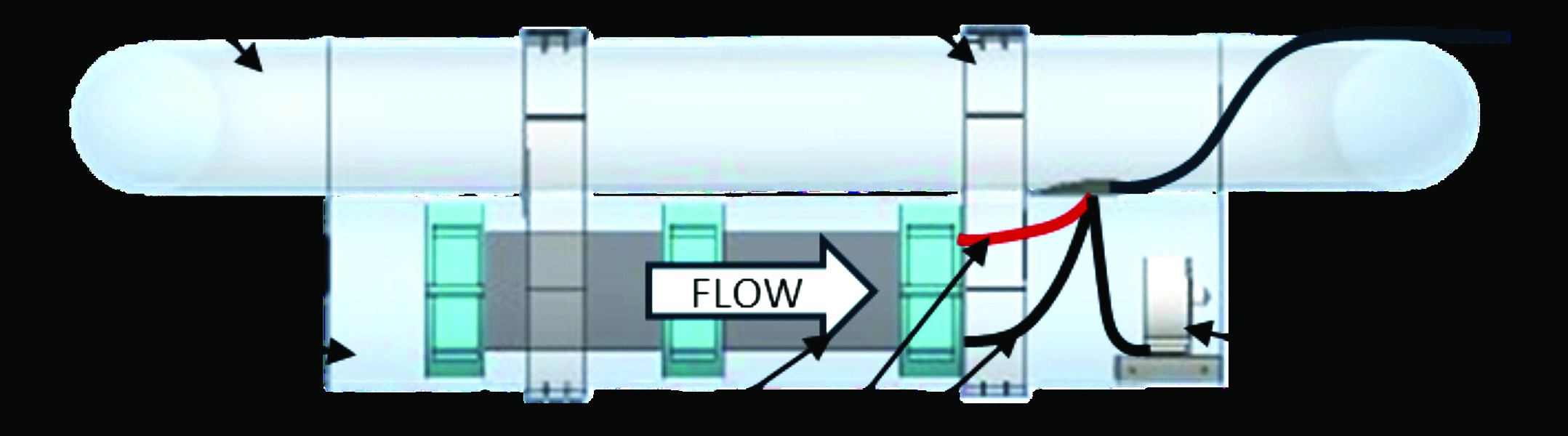
The SOLO configuration (Fig. 1) houses and suspends a floc generator cartridge just below the water surface. An impeller drives flow through the cartridge to treat water and promotes circulation in the basin, increasing mixing and enhancing floc formation. A controller is housed on top of the float.
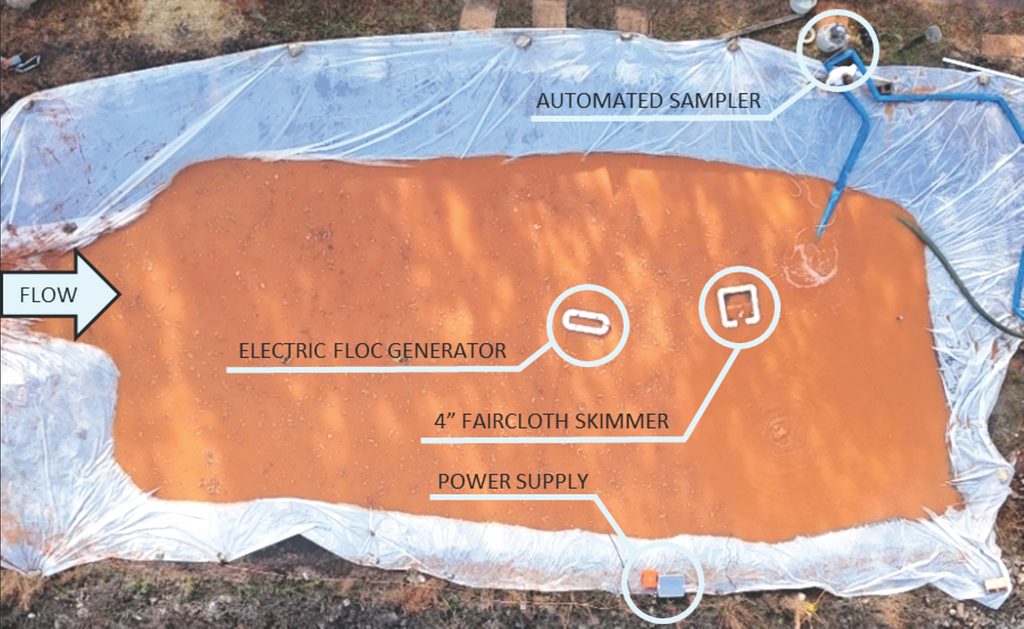
For the experiment (Fig. 2), SOLO was powered by a 12V DC power source located on the bank of the basin. The device was tethered to the basin bank with rope to maintain a fixed position during testing and serve as a retrieval line for removing the device following testing. A 4-in (10-cm) Faircloth Skimmer® was deployed in the basin as the primary dewatering device, and a valve located at the skimmer outlet allowed controlled discharge rates.
A Teledyne ISCO 6712 portable automated sampler was connected to a sampling port on the skimmer float and programmed to collect samples at specified time intervals. Discharge from the skimmer flowed through a calibrated 90° V-notch weir to measure flow rate. A second automated sampler was installed downstream of the weir to collect effluent samples during dewatering.
Basin influent was prepared by mixing water from a retention pond with sandy clay loam soil in a trough up to the 340 mg/L (650 NTU) concentrations typical of runoff on construction sites and introducing it to the sediment basin. The troughs included mechanical mixers to allow continuous homogenization of the sediment-laden inflow.
Once the water level in the basin reached the maximum volume without overtopping through an auxiliary spillway, researchers deployed the SOLO unit and activated the floc generator cartridge and impeller. Automated sampling from the skimmer head location was initiated at the start of the test.
The simulated runoff was detained and treated for 24 hours, with the automated sampler collecting samples hourly. Following the 24-hour treatment period, the skimmer valve was opened to initiate controlled dewatering, which continued for approximately 12 hours. Effluent discharged from the skimmer passed through the weir to monitor flow, and additional samples were collected hourly using the automated sampler downstream.
Control tests without the SOLO device were also performed to represent traditional settling conditions. This allowed comparisons between traditional sediment basin function and the electrical flocculation treatment process to quantify any improvement in turbidity reduction that the SOLO model provided.
Effluent samples leaving the basin were also collected to evaluate dissolved aluminum concentrations. While there are no stormwater effluent or surface water body standards for aluminum, the research team was interested in determining residual levels leaving the basin. Samples collected during testing were transported to the AU-SRF wet laboratory for analysis of turbidity and aluminum concentrations.
Yielding Impressive Results
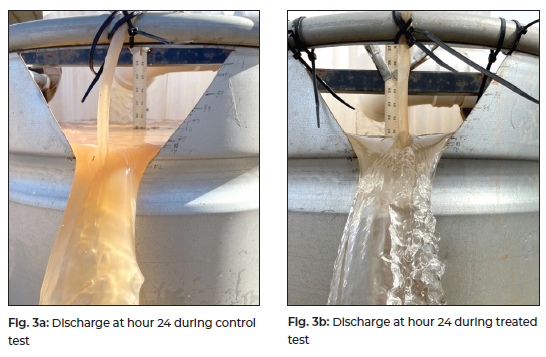
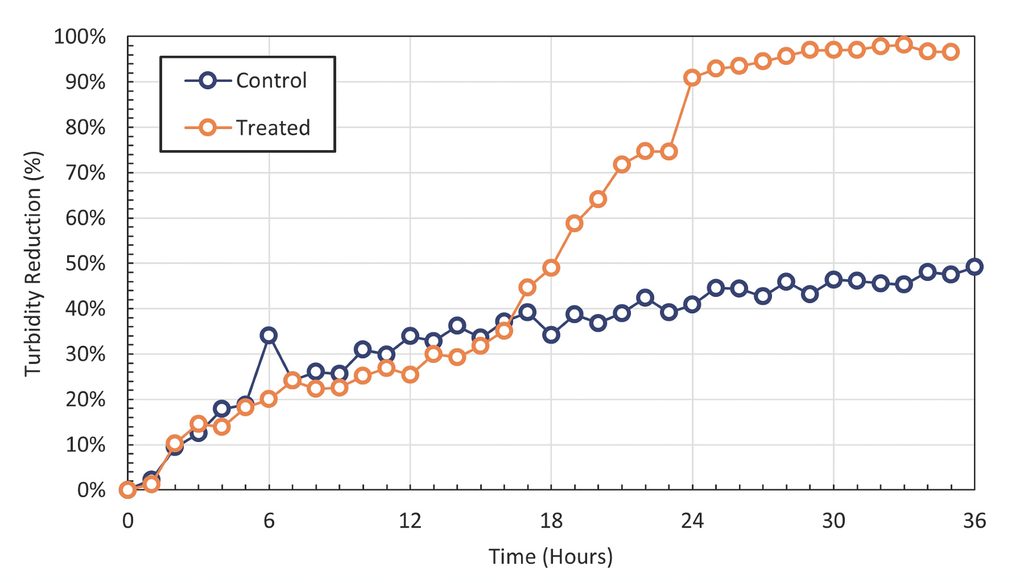
Turbidity comparisons between control and treated conditions demonstrated substantial improvement in basin clarification, highlighting the contrast between the initial treatment sample (Fig. 3a; hour 0; 390 NTU) and the final sample after 24 hours of treatment (Fig. 3b; hour 24; 7.2 NTU)—a 98% turbidity reduction. Fig. 4 shows turbidity reduction—the amount of turbidity reduced from the start of testing divided by the starting turbidity—for treated and control tests. The optimized SOLO system demonstrated improved performance above the previously tested end-of-pipe passive flow-through model. The SOLO operates in a batch configuration, where recirculation through the cartridge provides additional treatment.
At hour 18, there was a substantial increase in turbidity reduction for the basin treated with the floc generator. From hours 30–36, the electrified basin treatment plateaued, reaching a maximum turbidity reduction of approximately 98% by hour 36, whereas the control had achieved only a 50% reduction in the same time period.
Baseline dissolved aluminum concentrations measured during the control test were low, approximately 0.0002 mg/l to 0.0004 mg/l. Results from the treated tests showed a slight increase in dissolved aluminum concentrations, with concentrations ranging from approximately 0.0004 mg/l to 0.0018 mg/l.
Compared to chronic toxicity thresholds, measured dissolved aluminum concentrations during SOLO Floc Generator operation remained substantially lower—about 37 times lower than concentrations associated with adverse biological effects. The U.S. EPA Secondary Drinking Water Standard for aluminum is 0.05 to 0.2 mg/l, but this standard is based on total aluminum, not dissolved aluminum.
Floating a Solution
Large-scale sediment basin testing demonstrated that the SOLO Floc Generator can substantially enhance sediment capture in a sediment basin. Floc generator treatment improved turbidity removal beyond natural settling limits, achieving polishing to near-complete clarity (a 98% reduction) and producing visually clear discharge (7.2 NTU) during controlled dewatering. These results support the feasibility of a floating, batch-treatment electric floc generator approach for in-basin stormwater treatment.
Dissolved aluminum monitoring indicated minimal aluminum release during SOLO operation. Baseline dissolved aluminum concentrations during the control period were low and increased slightly during treatment and dewatering.
Future testing should be performed with the goal of expanding validation across additional water chemistry conditions (conductivity, temperature, and turbidity) and evaluating dissolved versus total aluminum fractions. Evaluation of non-sediment pollutant testing will begin soon and support ongoing development of the electric floc generator and operational guidelines for its safe field deployment.
Electric floc generators have broad applicability across a range of stormwater and water treatment scenarios, spanning 11 primary application environments and more than 50 individual applications. In each of these sectors (transportation, public facilities, recreation, residential, institutional, commercial, utility and infrastructure, agriculture, military and defense, industrial operations, and environmental remediation), the SOLO Floc Generator can be used to address key water quality concerns, including turbidity, heavy metals, and nutrient pollution. The SOLO floc generator applies the well-established electrocoagulation technology in a novel manner to improve settling in traditional sediment basins. Test results demonstrate strong potential for increased settling efficacy, and continued research will further optimize system performance and expand applicable use cases.
About the Experts
Grace Kerr, MS, EI, is a Ph.D. candidate in Auburn University’s Department of Civil and Environmental Engineering. She supports applied stormwater research through field testing, sample collection, and laboratory coordination.
Megan Sharpe, Ph.D., EI, CPESC-IT, is research and development lead at Fagan Consulting and directs development and testing of the electric floc generator. She has experience in prototype design, controls, and bench scale and field scale evaluation.
Barry Fagan, PE, PLS, ENV SP, CPMSM, CPESC, is owner and vice president of Fagan Consulting and has more than 32 years of experience in stormwater program delivery, applied research support, and implementation of water quality practices.
Michael Perez, Ph.D., PE, CPESC, is the Brasfield and Gorrie associate professor in Auburn University’s Department of Civil and Environmental Engineering. He directs the Auburn University Stormwater Research Facility.
References
1. S.J. Kerr, Silt, turbidity and suspended sediments in the aquatic environment: an annotated bibliography and literature review. Ontario Ministry of Natural Resources (1995).
2. B. Kazaz, Improvements in Construction Stormwater Treatment Using Flocculants, Auburn (2022).
3. R.A. McLaughlin and N. Bartholomew, Soil Factors Influencing Suspended Sediment Flocculation by Polyacrylamide, Soil Science Society of America Journal, Vol. 71, No. 2 (2007), doi: 10.2136/sssaj2006.0163.
4. M.Y.A. Mollah, P. Morkovsky, J.A.G. Gomes, M. Kesmez, J. Parga, and D.L. Cocke, Fundamentals, present, and future perspectives of electrocoagulation, Journal of Hazardous Materials, Vol. 114, No. 1–3. Oct. 2004, doi: 10.1016/j.jhazmat.2004.08.009.
5. J.N. Hakizimana et al., Electrocoagulation process in water treatment: A review of electrocoagulation modeling approaches. Elsevier B.V. (2017), doi: 10.1016/j.desal.2016.10.011.
6. S. Boinpally, A. Kolla, J. Kainthola, R. Kodali, and J. Vemuri, A state-of-the-art review of the electrocoagulation technology for wastewater treatment. KeAi Communications Co. (2023), doi: 10.1016/j.watcyc.2023.01.001.
Adapted from “Stormwater Recharged: Innovating With Electrical Flocculation,” which won IECA’s 2026 Technical Presentation of the Year Award in March