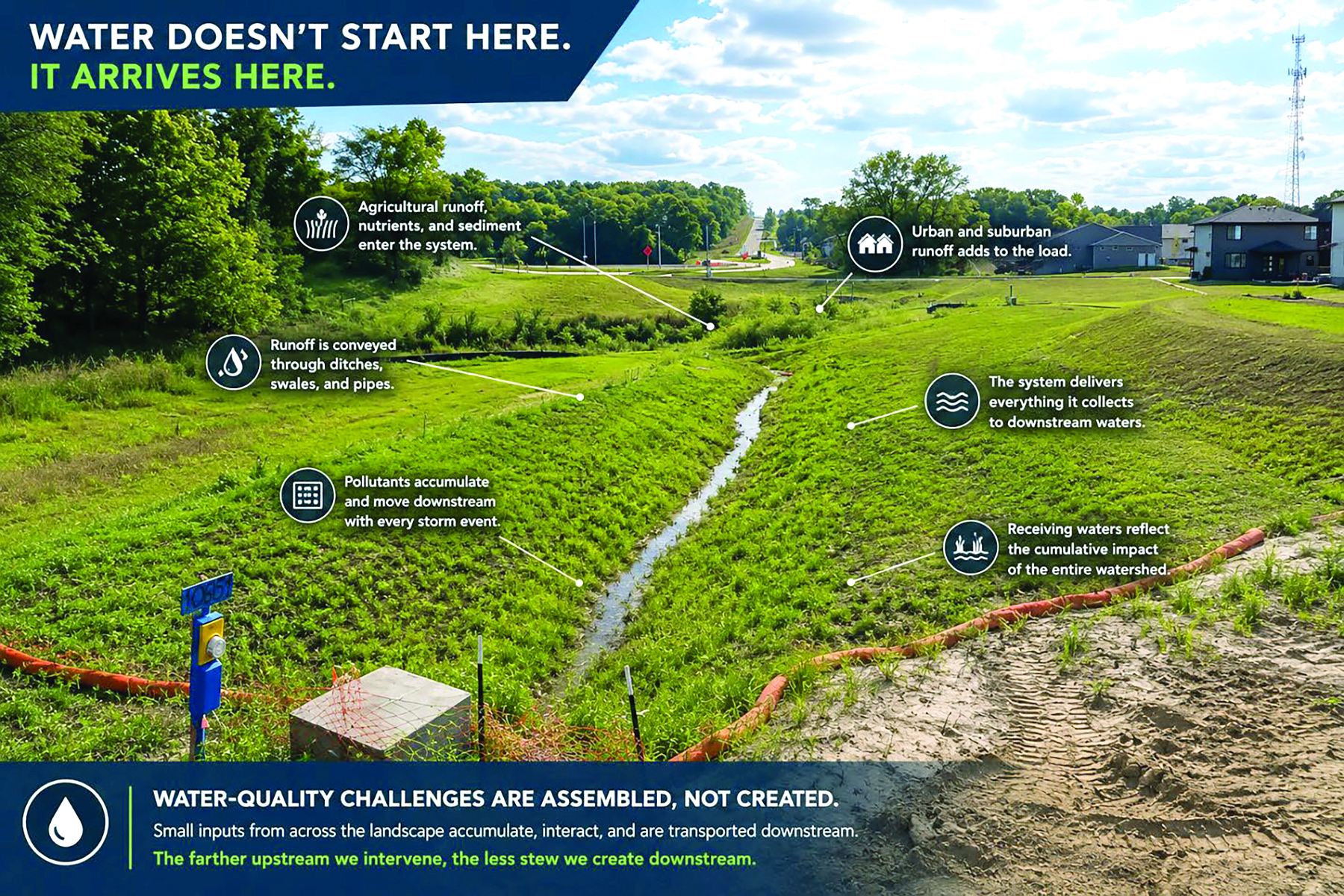
A trend toward global watershed management sees existing infrastructure and passive conveyance systems as treatment assets
By Corydon Coppola, CPESC
The longer I work around water, the less I view it as an environmental issue. I see our waters as a reflection of how we manage land, how we build communities, and ultimately, the legacy we choose to leave behind.
That realization didn’t come from a single project or a single watershed. It developed gradually over decades spent working around stormwater systems, agricultural drainage networks, public waters, reservoirs, construction sites, streams, rivers, and watersheds of every shape and size.
No matter where I found myself, I kept observing the same problems: An algal bloom, an impaired lake, a hypoxic reservoir, declining source-water quality, rising drinking water treatment costs, or a stream that no longer functioned the way it once did. These locations become the focus, because they made the consequences visible. But the visible problem was rarely where the story began.
The water arriving at those compromised locations had already completed its journey through fields, neighborhoods, roads, drainage systems, streams, tributaries, wetlands, ponds, and infrastructure. Along the way, it collected sediment, nutrients, organic matter, hydrocarbons, pathogens, metals, trash, and more. The symptom is simply where we finally notice the result.
Memories of Moving Water
For centuries, humankind has invested tremendous resources in moving water. We drain land so it can be farmed. We protect roads and infrastructure. We reduce flooding. We create systems capable of transporting water efficiently across entire landscapes. Those investments have created enormous benefits.
But while we became experts at moving water, we also became exceptionally good at moving everything that travels with it. Water carries sediment, nutrients, organic matter, hydrocarbons, pathogens—the story of the landscapes it passes through. The condition of our receiving waters often reflects the cumulative effects of everything occurring upstream.
One of the realities erosion and sediment control (ESC) professionals rarely discuss is that watersheds operate on timelines far longer than our projects, permits, budgets, or election cycles. Nutrients applied years ago may still be moving through a system. Sediment deposited decades ago may continue to influence downstream conditions. Groundwater may reflect decisions made long before the communities they supply existed.
In many respects, watersheds carry memories. Many of the challenges communities face weren’t created this year, or even this decade. They accumulated gradually over time, becoming part of the legacy inherited by those now charged with managing them.
Stewardship for Stronger Communities
That realization changed how I think about stewardship fundamentally. I no longer view it as simply an environmental obligation; I view it as a responsibility to people I will never meet.
Every watershed eventually becomes someone else’s watershed. Every stream eventually becomes someone else’s stream. Every river eventually becomes someone else’s source water. Every decision made upstream eventually influences someone downstream.
Once I began looking at watersheds through that lens, stewardship became more than compliance, permitting, or environmental management. It became a responsibility to future communities, future landowners, future ratepayers, and future generations who will inherit the consequences of the decisions we make today. That principle applies whether we are discussing recreation, fisheries, agriculture, drinking water, economic development, property values, or public health.
Public health does not begin in a doctor’s office. It begins in the communities and environments people experience every day. It is tied to the air we breathe, the food we consume, the soil supporting those food systems, and the water moving through our communities.
For too long, environmental health and public health have been discussed as though they are separate; they are not. People live downstream of the water we manage, and the quality of that water influences recreation, economic opportunity, property values, community identity, quality of life, and ultimately, human health.
Healthy water supports healthier communities. Healthier communities support stronger economies, and stronger economies create greater opportunities for stewardship. Everything is connected. Improving public water is one of the most direct investments we can make in public health.
The Power of Early Intervention
Another observation has surfaced throughout my career: The farther upstream we successfully intervene, the less “stew” we create downstream.
Most significant water-quality challenges are assembled, not created. Rarely can a challenge be traced to a single source, storm, or decision. Instead, small amounts of sediment, nutrients, organic loading, hydrocarbons, and other pollutants enter the system at different locations and at different times.
Individually, many of these contributions appear insignificant. Collectively, they accumulate, interact, and concentrate as they move through the watershed until conditions emerge that become increasingly difficult and expensive to manage.
What begins as countless small inputs distributed across a landscape can eventually become a significant downstream challenge. By the time such conditions become visible, the ingredients may have been mixing for decades.
Communities then invest substantial resources in attempts to manage the outcome through reservoir aeration, sediment removal, lake restoration, advanced treatment technologies, and countless other necessary interventions. Many of these tools provide important benefits, but they are frequently addressing conditions that have been developing long before action begins.
In many cases, pollutants are allowed to travel through an entire watershed before meaningful interception occurs. Nutrients move downstream before nutrient management becomes a priority. Sediment accumulates before sediment management begins. Source-water concerns emerge before source-water protection receives significant attention.
That raises an important question: If we understand where many of these materials originate and how they move through a watershed, why do we wait until they reach the end of their journey before attempting to improve the water?
Nature doesn’t operate that way. Healthy watersheds improve water continuously. Wetlands intercept nutrients, vegetation stabilizes sediment, floodplains store water, biological systems transform contaminants, and microbial communities process organic matter. Nature improves water throughout the journey, not just at the end.
Connecting Treatment Throughout the System
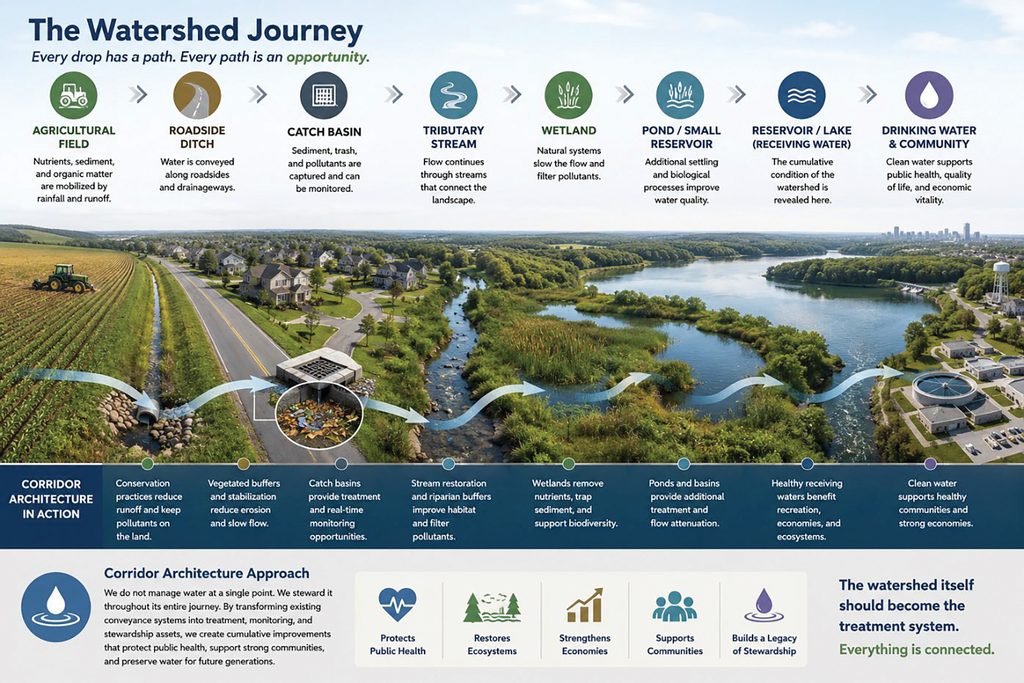
As these observations accumulated over the years, I began seeing that watersheds could benefit from a connected treatment strategy rather than a collection of disconnected projects and assets. That perspective ultimately became the OurWaters & OurSoils (OWOS) Corridor Architecture Approach™.
This system and others emerging in the industry offer a different way to view watersheds. They begin with the recognition that the greatest treatment opportunities often exist within the watershed that connects the source of a pollutant to the location where its impacts become visible.
This global viewpoint represents a shift from endpoint management to journey management. Historically, water-quality programs have often focused on either the source of a problem or the location where its impacts become visible. While both are important, the pathway between those two points offers the greatest opportunity to affect water’s journey. By transforming existing conveyance systems into distributed treatment, monitoring, and stewardship assets, communities can leverage infrastructure already present in the watershed to create cumulative improvements over time.
One of the most compelling aspects of this approach is that it doesn’t assume the need for new infrastructure. In many cases, the watershed already contains the assets necessary to begin improving conditions. The opportunity lies in recognizing additional value within systems that were originally designed only to convey water.
The drainageways, catch basins, tributaries, wetlands, ponds, reservoirs, and other components of the watershed already exist. Are we willing to recognize their value beyond conveyance and begin viewing them as part of an interconnected treatment and monitoring network?
Going Beyond Conveyance
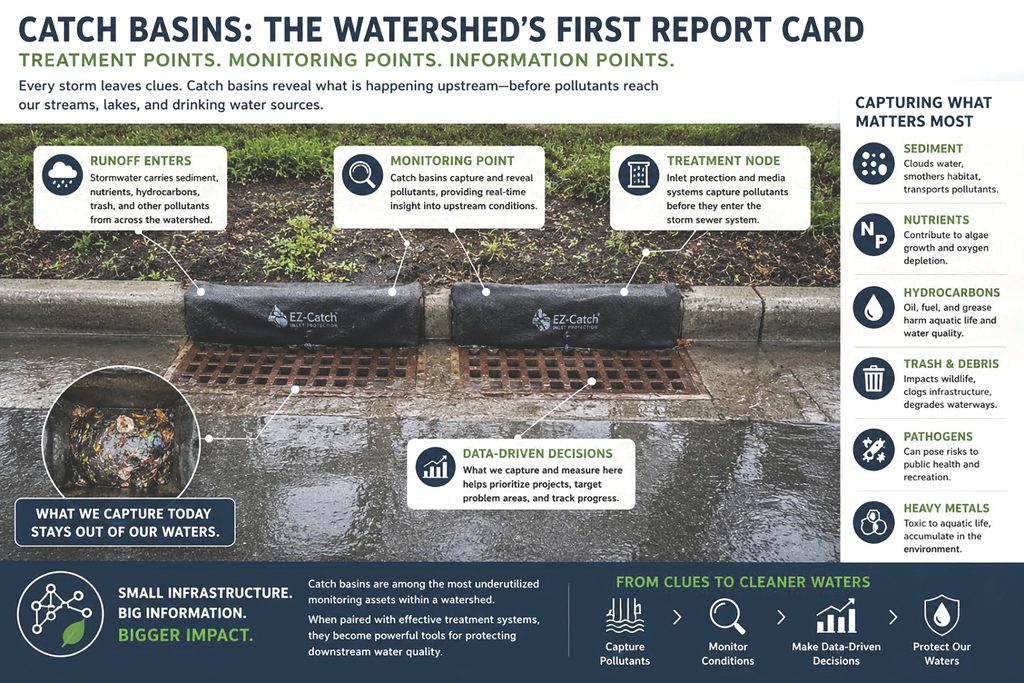
Catch basins provide a prime example. In a holistic watershed management approach, strategically selected catch-basin locations can be used as active treatment and monitoring points rather than solely as conveyance structures. OWOS’ proprietary technologies, for example, use existing stormwater infrastructure to support localized treatment while also providing insights into conditions within the contributing upstream watershed.
Every storm leaves clues. When sediment repeatedly accumulates in a catch basin, it points to upstream erosion and transport. When trash accumulates, it reveals behavioral, operational, or maintenance challenges in the drainage area. When hydrocarbons, organic matter, nutrients, metals, or other pollutants accumulate, they provide insight into the activities and land uses contributing to those conditions.
Unlike many monitoring programs requiring specialized equipment, laboratory analysis, or significant expense, catch basins can often provide immediate visual feedback about watershed conditions. In many respects, they function much like an environmental check-engine light, providing one of the earliest opportunities to observe what a watershed takes on before those materials reach ponds, reservoirs, tributaries, or oceans. Catch basins can help identify what should be captured and where additional investigation, management, or intervention may be warranted upstream.
The same principle applies to other components of a watershed. Every component of the corridor provides an opportunity to improve water quality and to better understand the conditions creating water-quality challenges in the first place.
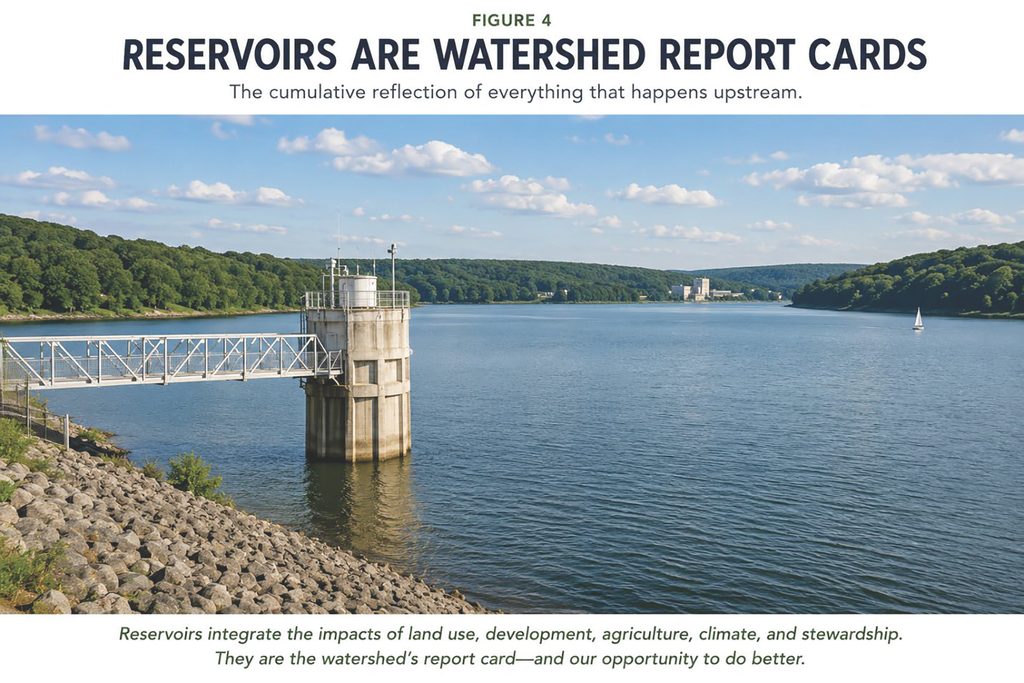
I often describe reservoirs as report cards (Fig. 4). A report card does not create the grade; it reflects the work that occurred beforehand. Reservoirs, lakes, and other receiving waters reveal the cumulative condition of everything occurring upstream. If we want to affect outcomes, we should pay greater attention to what happens before the report card is issued.
Embracing Systemic Strategies
Ultimately, holistic watershed management is built on a simple belief: The watershed itself should be the treatment system. The drainageways, catch basins, tributaries, wetlands, ponds, reservoirs, and countless other components of a watershed already form a connected network of opportunities capable of improving water quality, revealing emerging problems, and helping communities better understand the landscapes they manage.
Watershed-based thinking is becoming a foundational principle of modern water management. Across the United States, more watershed managers, conservation districts, utilities, and local governments are recognizing that water-quality challenges rarely respect political boundaries. Water follows topography, drainage patterns, and the natural movement of the landscape rather than jurisdictional lines.
A global approach builds upon that same philosophy, looking more closely at the systems that connect watersheds. Between the source of a pollutant and the location where its impacts become visible lies an extensive network of drainageways, catch basins, tributaries, wetlands, ponds, reservoirs, and conveyance systems. We must learn to see them not as pathways for moving water, but as opportunities to monitor and improve it.
Every watershed tells a story about the priorities, values, and decisions of the people who manage it. Some reflect decades of extraction; others reveal the consequences of neglect. Many of the healthiest watersheds have benefited from generations of stewardship and a willingness to think beyond the next project, permit, budget year, or election cycle.
The waters we leave behind will become part of the inheritance of future generations, just as the waters we manage today were inherited from those who came before us. So the question is not whether we leave a legacy; the question is whether the water leaving our care is healthier than when it became our responsibility.
Ultimately, stewardship can’t be measured by what we take from a watershed. It can only be measured by what we leave behind. And perhaps the greatest opportunity we have is to recognize that the journey itself may be our most valuable treatment asset. n
About the Expert
Corydon Coppola, CPESC, is president and cofounder of OurWaters LLC, dba OurWaters & OurSoils (OWOS). Coppola works on nature-based and infrastructure-integrated approaches to distributed water-quality treatment, including Connected Watershed Architecture™, the Corridor Architecture Approach™, and EZ-Catch™ technologies. For more information, email Corydon@OurWaters.org or call 515-577-6763.