
Emerging contaminants present novel treatment challenges for constructed wetlands
By Erin Rivers, Ph.D.
Constructed wetlands are one of the most versatile best management practices (BMPs) for improving water quality. Originally developed to reduce sediment, nutrients, and organic matter from stormwater and wastewater, they are now expected to tackle a broader suite of pollutants, including pharmaceuticals, per- and polyfluoroalkyl substances (PFAS), and microplastics.
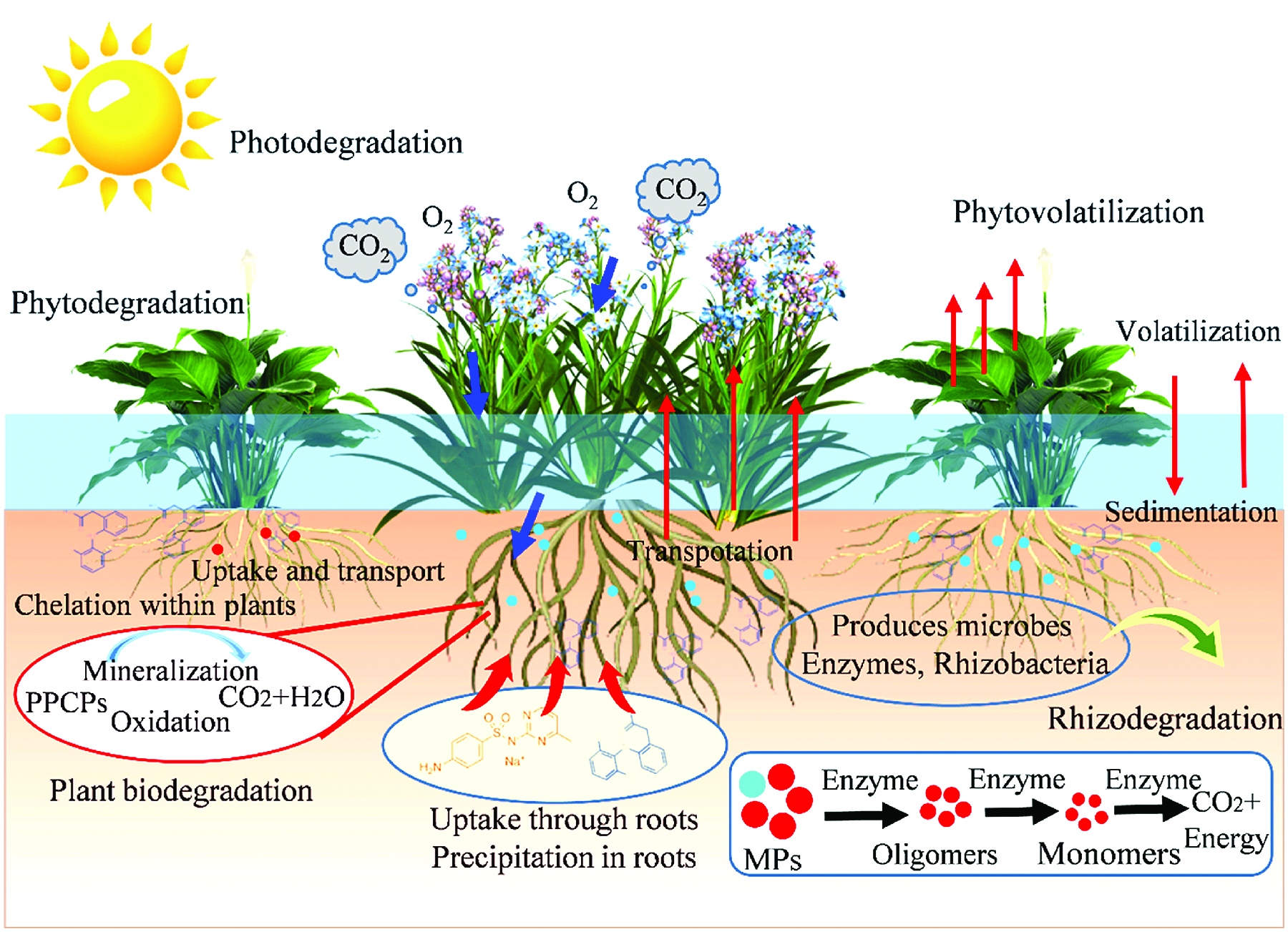
That shift reflects changing water quality challenges as much as it does advances in wetland science and watershed management. Several recent review studies synthesize this rapidly expanding body of research, examining how contaminant chemistry, wetland hydraulics, and ecological processes influence treatment performance.1–4 Rather than viewing wetlands as passive filters, these studies describe them as dynamic treatment ecosystems whose effectiveness depends on the interaction of physical, chemical, and biological processes (Fig. 1).
For decades, the design of treatment wetlands has been guided by a relatively straightforward objective: Slow the flow of water, settle suspended solids, and create conditions that promote nutrient uptake and microbial transformation. Those remain the fundamental functions of constructed wetlands, but emerging contaminants present a different challenge.
Unlike sediment and nutrients, pharmaceuticals, PFAS, and microplastics differ dramatically in their chemical properties, persistence, mobility, and susceptibility to biological degradation. As a result, no single treatment mechanism can effectively address every contaminant entering a wetland.
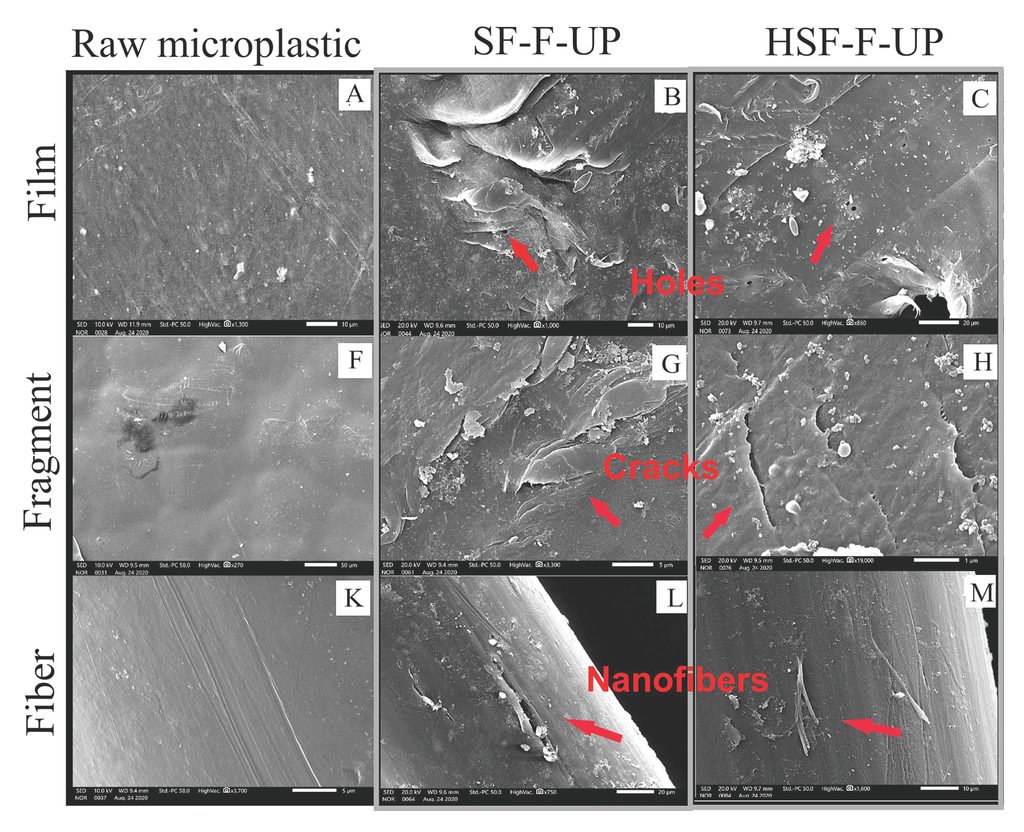
fragments, and fibers after passage through surface flow (SF) and horizontal subsurface flow (HSF)
constructed wetlands. Compared with raw materials (left column), particles exposed to wetland treatment
exhibit holes, cracks, and surface weathering, illustrating that constructed wetlands can alter retained
microplastics rather than simply trap them.
Compound-Specific Contaminant Removal
As a result, contaminant chemistry largely determines how removal occurs, recent literature says. Pharmaceuticals including many antibiotics are susceptible to microbial degradation and can also be adsorbed onto wetland substrates or taken up by vegetation. Around plant roots, diverse microbial communities transform compounds that might otherwise persist in the water column.1
PFAS present a greater challenge: Their exceptionally strong carbon-fluorine bonds make them highly resistant to degradation, leaving adsorption to soils, organic matter, and engineered substrates as the primary removal pathway.3 Microplastics also behave differently; because they exist as particles rather than dissolved contaminants, wetlands retain them through settling, filtration, and interception by vegetation before slower physical and biological processes begin to alter them.1
For practitioners, the implication is straightforward. There is no universal constructed-wetland removal mechanism for emerging contaminants, and performance depends on matching the dominant treatment processes in a wetland (adsorption, microbial transformation, filtration, or plant uptake) to the physical and chemical properties of the contaminants being treated.
For example, a wetland designed primarily to capture suspended sediment may not provide the conditions needed to degrade pharmaceuticals. Likewise, systems that perform well for nutrient removal may be less effective for persistent compounds that depend almost entirely on adsorption processes.3,5
Hydraulic Controls on Treatment Performance
Hydraulics emerge as another recurring theme throughout recent research. Regardless of the removal mechanism, contaminants must remain in contact with biologically active substrates, microbial biofilms, and plant roots long enough for treatment to occur. Therefore, residence time is a critical control on contaminant removal.
When water short-circuits residence time through preferential flowpaths or bypasses treatment zones altogether, removal efficiency declines. Under these conditions, even highly reactive media or vigorous plant communities can’t compensate for poor hydraulic performance.2,3 This represents an important shift in how researchers evaluate treatment wetlands.
Earlier studies often focused on reporting removal percentages for individual contaminants. More recent work asks a different question: What controls treatment performance? Increasingly, the answer points back to hydraulic function.
Flow distribution, wetland configuration, substrate selection, and hydraulic loading determine whether contaminants encounter the conditions necessary for adsorption, microbial transformation, or plant uptake.2 Improving hydraulic processes may ultimately produce better performance than simply changing plant species or adding
new media.
The Effect of Emerging Contaminants
The literature also reveals something equally important: Contaminants influence wetlands just as wetlands influence contaminants. Treatment systems are living ecosystems supported by interactions among plants, microorganisms, soils, and aquatic organisms. Introducing emerging contaminants can alter those interactions in ways that affect long-term performance.
For example, antibiotics may suppress microbial activity, shift microbial community composition, and interfere with the enzyme systems responsible for nitrogen cycling while also contributing to the persistence and spread of antibiotic resistance genes.1
Microplastics introduce a different set of challenges. Although wetlands are generally effective at retaining plastic particles, capture is only the beginning of the story. Once microplastics are deposited in wetland sediments, they continue to weather, fragment, and develop microbial biofilms (Fig. 2). Adsorption of metals and other organic contaminants to the surfaces of microplastics can cause them to become carriers for additional pollutants. Some studies also suggest that long-term accumulation may alter microbial diversity, reduce nitrogen removal, and influence greenhouse gas emissions.4 As a result, the contaminants can gradually change the ecological processes responsible for treatment.
These findings reinforce the idea that constructed wetlands are more than just engineered basins designed to slow water. They are ecological treatment systems whose performance depends on maintaining healthy biological communities alongside effective hydraulic function. Designing for contaminant removal therefore requires more than selecting an appropriate substrate or plant species. Long-term ecological function is of equal importance.
Implications for Stormwater and Restoration Practices
Looking ahead, researchers are envisioning a new generation of constructed wetlands capable of addressing multiple treatment objectives simultaneously. Rather than focusing exclusively on nutrients and suspended solids, future systems may incorporate specialized adsorption media, intermittent aeration, electrochemical enhancement, or hybrid configurations that improve treatment of persistent contaminants while maintaining the ecological benefits that make wetlands attractive in the first place.2 Many of these approaches remain experimental, and the recent reviews consistently emphasize the need for additional field-scale monitoring.
Lab and pilot-scale studies have advanced our understanding considerably, but important questions remain about long-term media saturation, maintenance requirements, treatment reliability under variable hydrologic conditions, and how these systems perform over decades rather than years.3
Constructed wetlands are no longer judged solely by how well they remove sediment or nutrients. They are increasingly expected to function as resilient, multifunctional treatment systems capable of addressing an expanding range of contaminants. Recent research suggests they are well positioned to meet many of those challenges, but only when contaminant chemistry, hydraulic design, and ecological function are considered together. Meeting those expectations will require designs that integrate hydraulics, substrate selection, plant communities, and microbial ecology not as independent components, but as parts of a single, interconnected treatment ecosystem.
About the Expert
Erin Rivers, Ph.D., is an assistant professor of Crop and Soil Sciences who has expertise in stormwater management construction and postconstruction situations in the West Coast, Midwest/Rocky Mountain, and East Coast regions.

References
1. Hou, Y. et al. Constructed wetlands for emerging contaminants removal: Current status of antibiotics, microplastics, and their effects on nutrient transformation processes. Emerg. Contam. 12, 100673 (2026).
2. Liu, A. et al. Exploring advanced measures of constructed wetland for the improved removal of emerging contaminants. J. Environ. Manage. 401, 129005 (2026).
3. Savvidou, P., Dotro, G., Campo, P., Coulon, F. & Lyu, T. Constructed wetlands as nature-based solutions in managing per- and polyfluoroalkyl substances (PFAS): Evidence, mechanisms, and modelling. Sci. Total Environ. 934, 173237 (2024).
4. Zhang, X. et al. Microplastics in constructed wetland ecological systems: Behavior, fate and environmental risks. Water Res. 303, 126239 (2026).
5. Mumtaj, Z. A. et al. Removal of pharmaceutical contaminants from hospital wastewater using constructed wetlands: a review. Environ. Sci. Pollut. Res. 31, 12856–12870 (2024).
6. Chen, Y. et al. Transport and fate of microplastics in constructed wetlands: A microcosm study. J. Hazard. Mater. 415, 125615 (2021).