
How high-intensity rainfall events are redefining erosion control
Erosion and sediment control (ESC) practices protect soils from the erosive forces of rainfall by promoting infiltration and slowing runoff. But the effectiveness of these practices is not static; it is a function of rainfall intensity and duration.
Extreme precipitation events are becoming more frequent and intense due to increasing average annual temperatures and an accelerating hydrological cycle. This shift poses a direct challenge to ESC approaches, because most standard designs are based on historical rainfall data that may not reflect current weather realities.
A few high-intensity events often drive a majority of annual sediment loss. Recent research across three environments emphasizes that extreme events play a disproportionately large role in sediment transport, suggesting that design approaches centered on average conditions likely underestimate how systems respond in a changing climate.
Storage and Surge
A multidecade study was conducted in the Rivière des Remparts Canyon on Réunion Island, an overseas department of France in the Indian Ocean, to understand the long-term impact of extreme weather.1 The watershed is a deeply incised, ephemeral system that sits on the flank of an active volcano and experiences a tropical monsoon climate characterized by intense rainfall. By using historical aerial imagery and photogrammetry, the study linked landscape change to rainfall records from 1950–2011.
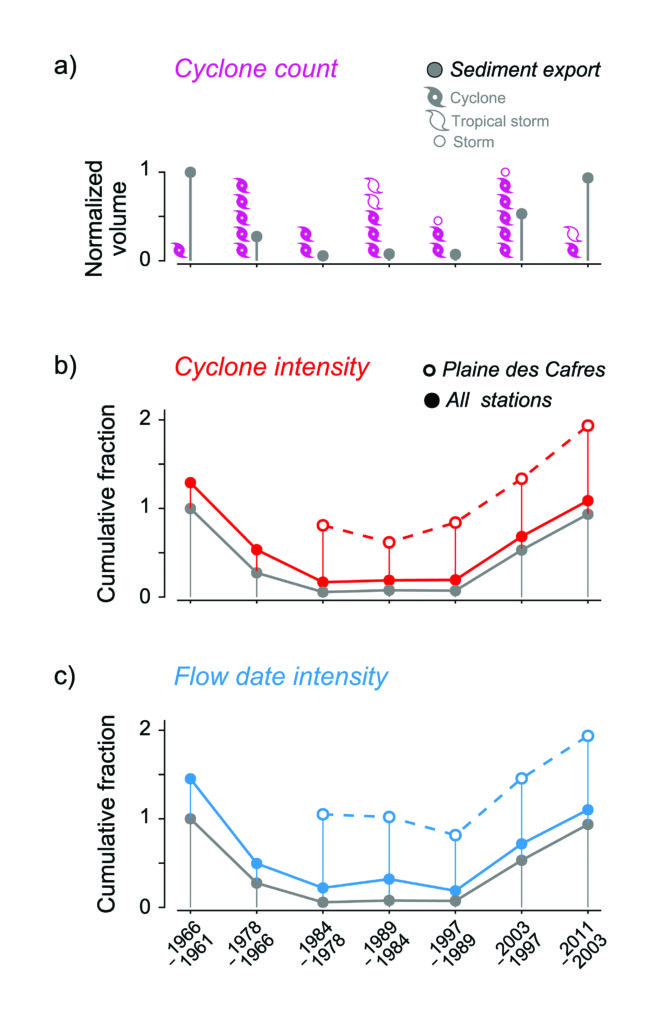
Over the 62-year study period, nearly 50 million m3 (65 million yd3) of sediment were eroded from the watershed. However, sediment transport was highly intermittent, occurring during 1.7% of the total observation window (391 days). Erosion risk and sediment export were almost entirely driven by cyclones and high-percentile precipitation events (Fig. 1).
During these windows, intense rainfall rapidly mobilized stored material and triggered mass wasting, flushing sediment through the system in rapid surges. Ultimately, the canyon functioned as a “storage and surge” system, where material accumulates on hill slopes and floodplains over time, only to be remobilized when extreme thresholds are crossed. This highlights that a system that appears stable for years may simply be in a storage phase, waiting for a threshold-crossing event to mobilize its internal load.
Exceeding Design Thresholds
The same storage and surge behavior was observed in an engineered and managed river system. A study of the 2021 Meuse River flood in the Netherlands examined how extreme precipitation affects erosion within a managed channel.2 The study used a multidisciplinary approach combining high-resolution field monitoring with hydrodynamic modeling to examine the mechanisms behind this event. Bathymetric bed surveys were conducted three days post-flood to identify localized scour, and LiDAR water surface observations were used to detect the presence of large underwater dunes that significantly increased flow resistance.
To isolate the impact of human engineering, researchers used hydrodynamic model simulations to compare the 2021 flood wave against the river’s 1995 geometry. Modeling results showed that uneven river widening projects had created artificial bottlenecks, increasing maximum flow velocities by up to 30% and increasing sediment exports more than five times higher than historical benchmarks.
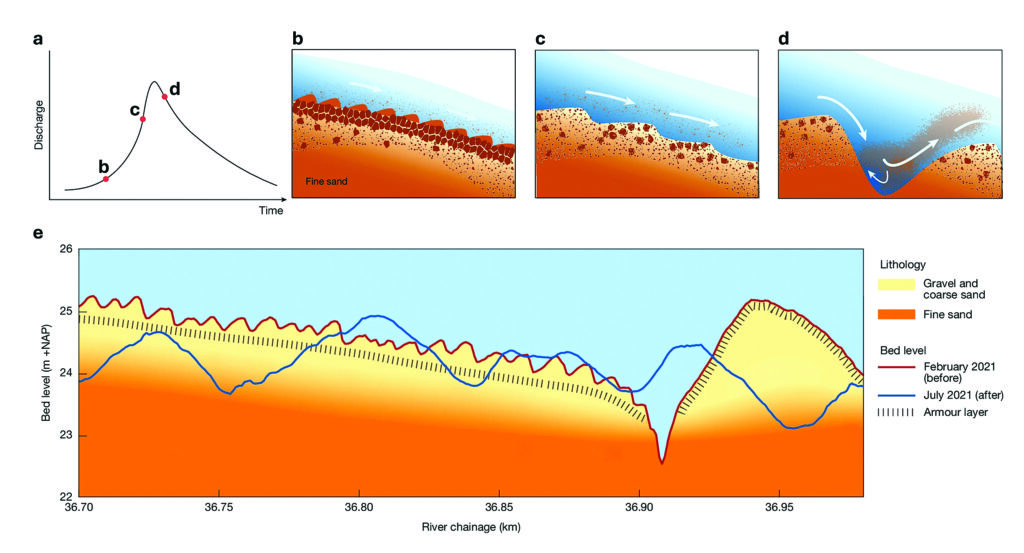
The 100-year 2021 Meuse River flood produced rapid spikes in discharge and flow velocity, causing extensive scour of the riverbed and banks. Approximately 500,000 m³ (653,975 yd3) of sediment was exported during this single event, exceeding typical annual transport volumes by an order of magnitude. Erosion was not uniform across the reach; it was concentrated where flow accelerated at channel constrictions, transitions, and areas where infrastructure forced water into constricted flow paths.
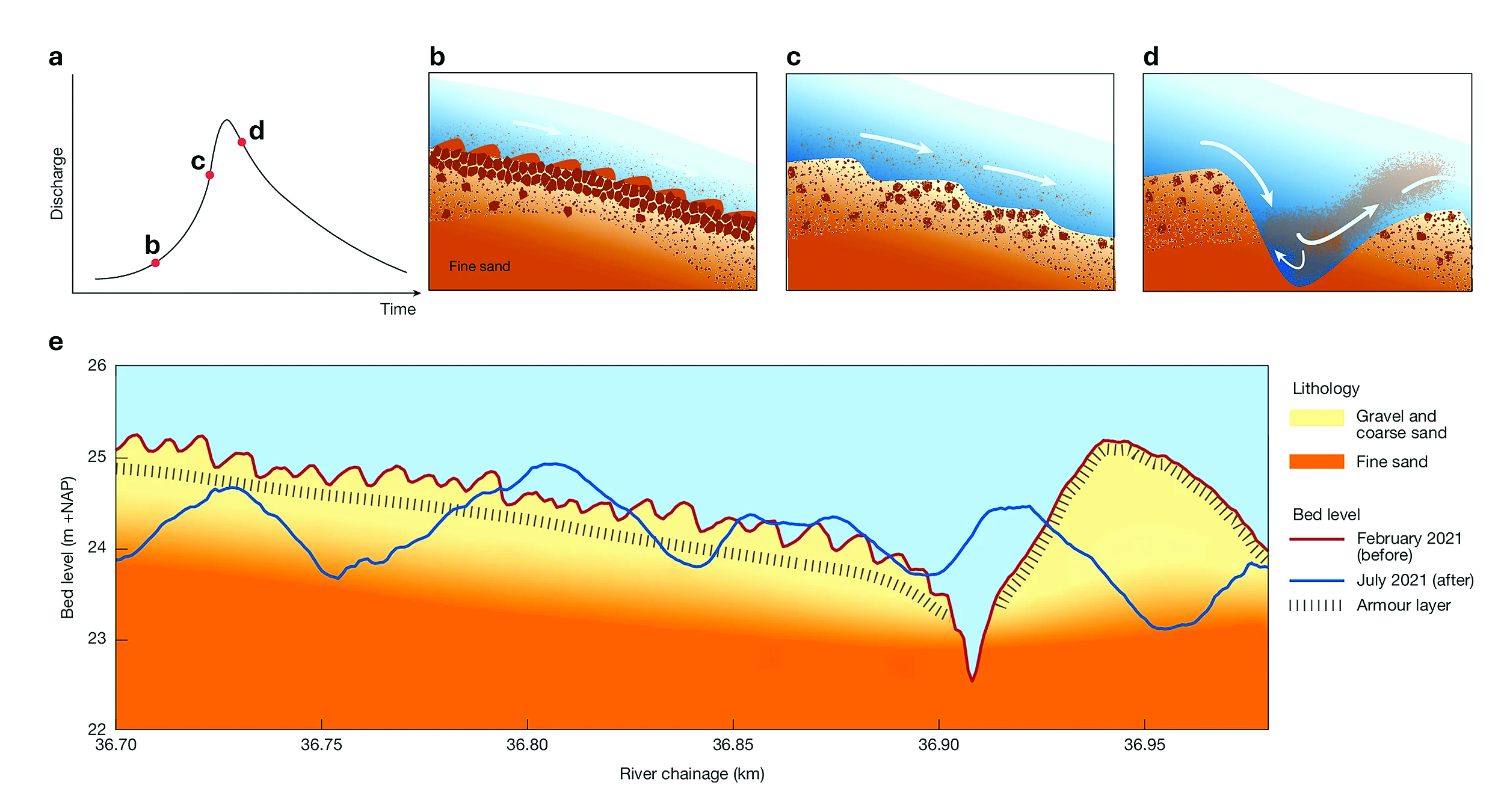
In the study, coarse surface armor layers masked highly erodible subsurface materials. After high flows disrupted the surface armor layer, the underlying sediments were rapidly mobilized, resulting in deep scour and channel instability (Fig. 2). This shows that a site or channel that appears stable under moderate conditions may harbor latent vulnerabilities that are revealed only when hydraulic thresholds are exceeded.
Construction Site Monitoring
At the construction scale, field monitoring confirms that fundamental processes operate at smaller spatial and temporal increments. A recent study of active road construction sites in Ohio evaluated how rainfall characteristics influence sediment loss from exposed soils under real-world conditions.3
Eleven monitoring locations were established across three active road construction sites in central Ohio. Grab samples were collected during storm events to analyze total suspended solids (TSS), turbidity, and particle size distribution (PSD). To identify the specific drivers of erosion, researchers correlated water quality parameters with high-resolution rainfall data, including intensity, duration, and soil antecedent moisture conditions. The immediate physical response of disturbed soils to high-energy precipitation was quantified by isolating the rainfall intensity occurring in the 10-minute window immediately preceding runoff.
Sediment concentrations in runoff were highly dynamic, with total suspended solids (TSS) ranging from 25 to 28,600 mg/L and turbidity reaching 33,000 NTU. This extreme variability reflects the episodic nature of erosion during storm events. Sediment loss did not increase gradually with total rainfall but instead responded sharply to short-term changes in rainfall intensity.
Rainfall intensity in the 10 minutes prior to runoff was the strongest predictor of sediment concentration. Higher intensities increased the shear stress on exposed soils, leading to greater particle detachment and transport. Conversely, storms of longer duration were associated with finer particles, likely due to the breakdown of soil aggregates under saturated conditions. This suggests that ESC measures—particularly those designed for filtration or settling—must be sized to handle the hydraulic peaks of such 10-minute bursts, as these short windows drive the bulk of the sediment load leaving a site.
Navigating New Realities
Together, these studies demonstrate that erosion under extreme rainfall differs fundamentally from typical conditions. To maintain stability in an increasingly unpredictable climate, ESC approaches should shift from designing for averages to designing for hydraulic thresholds. Here’s how ESC professionals should proceed:
- Acknowledge the storage/surge dynamic. Stability between storms should not be mistaken for permanent resilience, as a single event can move a year’s worth of sediment. Prioritize maintenance and regularly clean catch basins and traps to ensure stored volumes are not available for remobilization during the next major surge.
- Account for nonlinear system responses. A 20% increase in intensity can trigger a system reset rather than a proportional increase in soil loss. Model how a system fails when design limits are exceeded to stress-test designs and identify where overflow will go and which latent materials will be exposed.
- Address increased system connectivity. Extreme events effectively erase the buffer zones between hill slopes and channels, allowing material to move through the entire watershed with minimal resistance. Focus on intensity—not just volume—by prioritizing BMPs that provide immediate energy dissipation at the soil surface before runoff can gain momentum.
- Manage shifting hydraulic controls. During extreme events, systems transition from being infiltration-limited to being controlled entirely by the energy of moving water (shear stress). Pay particular attention to channel constrictions and bottlenecks. Focus on geometry and transitions to identify where shear stress will peak and where erosion is most likely to initiate.
- Identify and protect latent weaknesses. High-energy events find the weakest link, such as erodible subsurface layers masked by a stable surface. Be aware of subsurface vulnerabilities and ensure that the soil underlying a protective layer such as riprap or turf reinforcement mats can resist rapid mobilization if the surface layer is breached.
By moving beyond average performance metrics and focusing on how systems respond to extreme thresholds, ESC approaches can better prepare for extreme events. n
About the Expert

Erin Rivers, Ph.D., is an assistant professor of Crop and Soil Sciences who has expertise in stormwater management construction and postconstruction situations in the West Coast, Midwest/Rocky Mountain, and East Coast regions.
References
1. Gayer, E., Lucas, A., Michon, L. and Gougeon, M. Evidence for Erosional Efficiency of Extreme Precipitation Events at a Multi-Decadal Time Scale. Journal of Geophysical Research: Earth Surface 130, e2024JF007818 (2025).
2. Barneveld, H. J. et al. Extreme river flood exposes latent erosion risk. Nature 644 (2025).
3. Grimm, A. G., Tirpak, R.A. and Winston, R.J. Monitoring the impacts of rainfall characteristics on sediment loss from road construction sites. Environmental Science and Pollution Research 31, 32428–32440 (2024).