
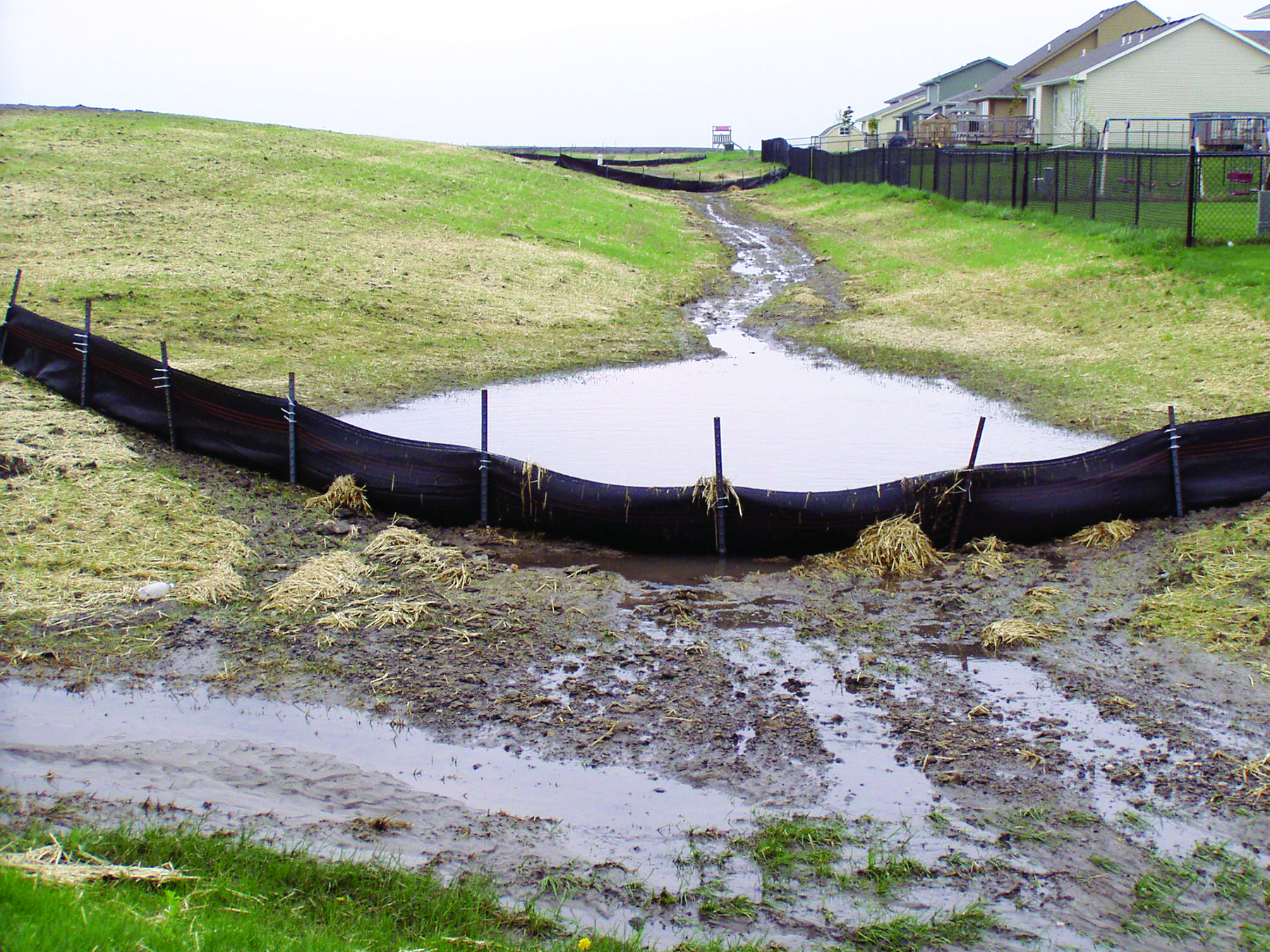
The industry must focus on using its tools effectively
Owners pay for Stormwater Pollution Prevention Plan (SWPPP) compliance, regulators get paid to monitor SWPPPs, and contractors get paid for installing SWPPP infrastructure. Our industry is part of this system, providing education, certification, inspection, employment, and installation. But there is clear evidence of ineffective sediment controls—or at least poorly maintained sediment controls—all over the country.
Such “cosmetic” sediment control solutions are the result of poorly installed, poorly maintained, and therefore ineffective best management practices (BMPs). Inadequate design and “box-checking” by inspectors and regulators play a part. An industry that spends so much time, money, and energy on environmental protection must not allow such cosmetic BMP controls to persist.
What Makes Controls Ineffective?
Silt fences that sit on the ground, wattles and socks that have floated downstream or have a channel running underneath them, and other installations that are not constructed to direct storm water runoff into sediment pond(s) are a few examples of cosmetic controls.
If sites are inspected and reported on after every runoff event, how can these controls be left in clear violation week after week? How can designers, owners, managers, contractors, inspectors, and regulators not see dysfunctional controls when they are at a site?
This discussion also applies to sediment retention that focuses on heavier, sandy soil particles. Sand particles are the most important to retain, as large volumes contribute to accelerated erosion downstream or sediment accumulation where accumulation isn’t desired. Design is important to sediment control effectiveness, but installation and maintenance are where the rubber hits the road.
“Temporary” sediment controls means before erosion control begins, not short-term or unimportant. Most sediment retention devices should pond water for at least a few hours or retain considerable sediment after a runoff event to be effective. If they fail to do so, the control devices should be repaired or replaced in a timely manner.
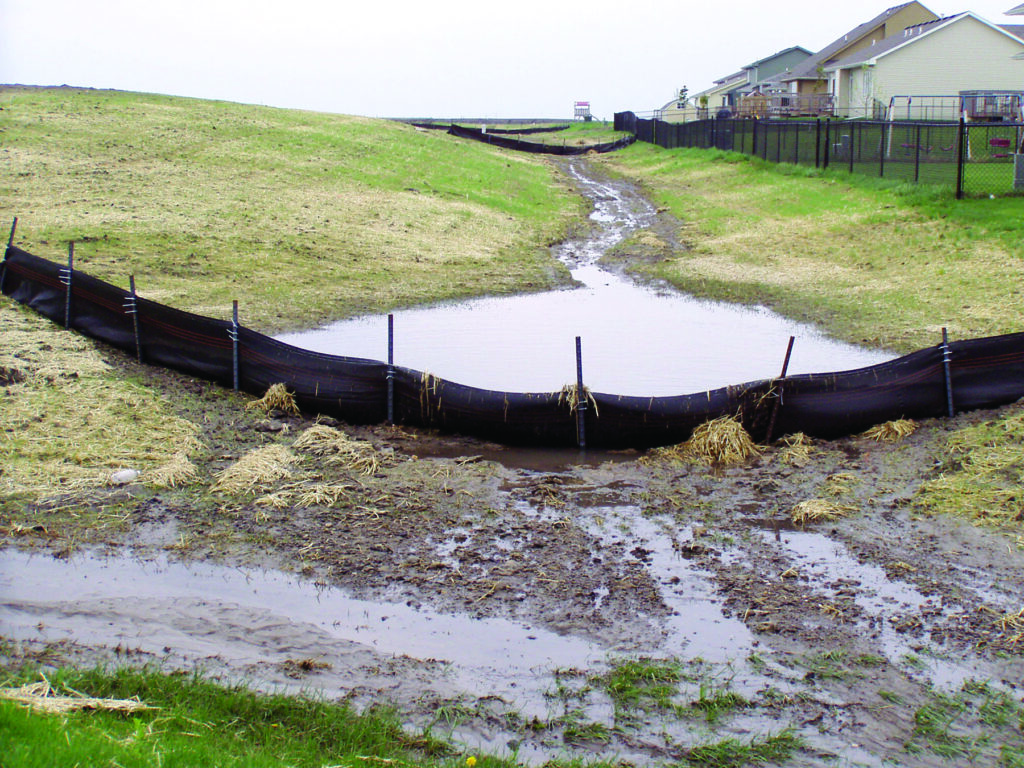
Common Sediment Retention Devices
Silt fences represent the most established BMP. Inserting a fabric framework into the ground allows sedimentation to occur by ponding water upstream of the fence; different configurations allow more or less water through, and greater spacing between posts allows more stretching.
Even when a silt fence is supported to minimize stretching, clay and silt particles tend to build up and “blind” the filtering fabrics. This can create significant ponding, allowing sand and silt to settle out behind the silt fence. A properly installed and placed silt fence may blind and allow some runoff, but the majority of sand particles will settle out behind the fence and be retained on-site, making the silt fence BMP a very effective sediment-retention device.
But the majority of silt fences are not installed or maintained properly. The soil holding the silt fence base isn’t properly backfilled or gets compacted, or the fence is not placed to pond water effectively. With little or no compaction, runoff buildup and ponding will pipe underneath the silt fence and wash it out.
When a site is properly stabilized and the SWPPP BMPs are no longer needed (typically three to nine months after project completion), the BMPs should be removed. What often happens instead is that the ESC contractor that installed the BMPs is no longer under contract, and the owner doesn’t want to pay extra for them to come back. The BMPs then become nuisances that need to be addressed by the property owner, the local municipality, or the homeowners association.
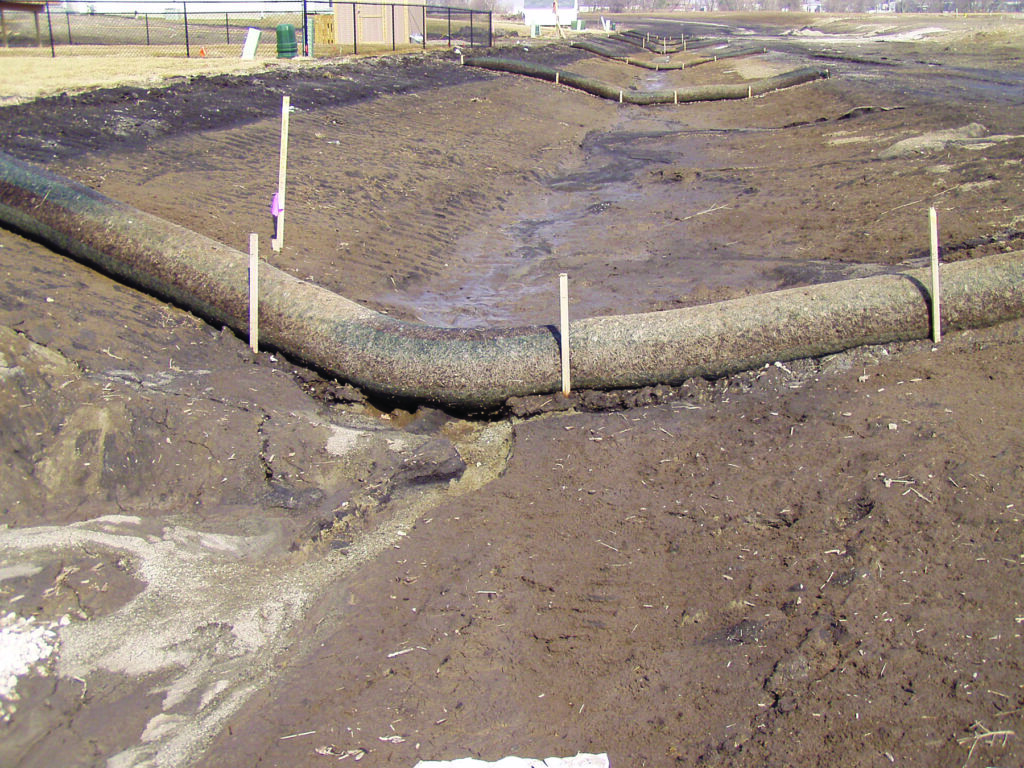
Wattles and socks vary in size from about 6 in (15 cm) to 15 in (38 cm) in diameter and are filled with a variety of materials from straw to lawn waste to compost to rocks. Generally, they impede runoff velocity and retain sediment on-site. Stakes are occasionally used to press them onto the ground and prevent them from moving or floating.
Wattles and socks have their own installation and placement issues, however. Since they sit on top of the soil, it doesn’t take much ponding before water begins to pipe underneath. Fills for these devices are often blown in under pressure, leaving little void for sediment. Like silt fences, few wattles and socks are seen with volumes of sediment behind them and sometimes are left on-site to decay in place, usually when filled with a substance that decomposes.
The tools we have can be effective, but if they are installed only to check a box, it reflects poorly on the ESC industry by wasting money and harming the environment. The industry needs to ensure that the BMP controls we install retain sediments effectively, are maintained properly, and are reinstalled when damaged—and that the accumulated sediment is removed when necessary.
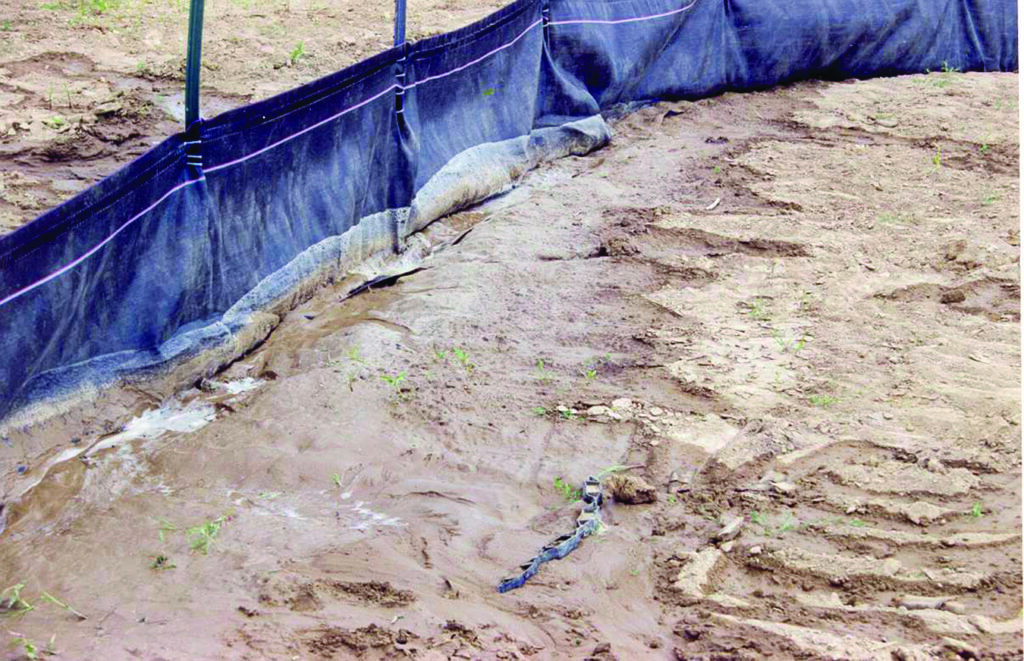
allow sediment to pass.
About the Expert
Thomas Carpenter, CPESC, has worked in the erosion and sediment control industry for nearly 30 years as the owner of an inspection company and ESC business. He has funded and supported major research projects on sediment control BMPs and performed thousands of SWPPP inspections.
Resources
- EPA tech sheet on silt fences: bit.ly/4ueOUZY
- The author’s guide to proper silt fence installation and maintenance: bit.ly/4flIF1M
- University of Michigan guide to straw wattle installation: bit.ly/3R9nwxV