Arid environments need a purpose-built, plantfocused
erosion control blanket solution
SLOPE STABILIZATION IN ARID and semi-arid regions is a challenge for infrastructure projects when disturbed soils are exposed to intense rainfall, wind, and extreme temperatures with low relative humidity. Conventional erosion control products designed for more humid climates often fail under these conditions.
A climate-adapted, plant-based slope stabilization approach that uses a durable, permeable, high-albedo erosion control blanket engineered for arid environments can help. Such a system would promote the establishment of native, drought-tolerant grasses and shrubs with root systems that improve soil reinforcement, ecological recovery, and visual integration of disturbed landscapes. A scalable, cost-effective solution would enhance slope stability and aesthetics in arid conditions.
Arid and semi-arid landscapes often experience accelerated soil degradation due to the combined effects of vegetation loss, high-intensity convective rainfall, expanding infrastructure, and climate variability. Unlike humid environments, arid regions lack continuous plant cover and organic-rich topsoils capable of buffering erosive forces. As a result, even short storm events can generate extreme runoff coefficients, rill initiation, and rapid sediment transport, creating legal problems for construction projects such as highways, bridges, and mining sites.
Typically optimized for temperate climates, conventional erosion control blankets often fail under arid conditions because they degrade
too quickly under ultraviolet radiation, retain excessive heat, or lack sufficient thickness to dissipate raindrops’ kinetic energy and minimize
soil water evaporation. And although the recommendation is often to rely on structural solutions rather than plants, a purpose-built erosion control blanket engineered for plant based slope stabilization projects is needed in arid regions.
Performance Criteria
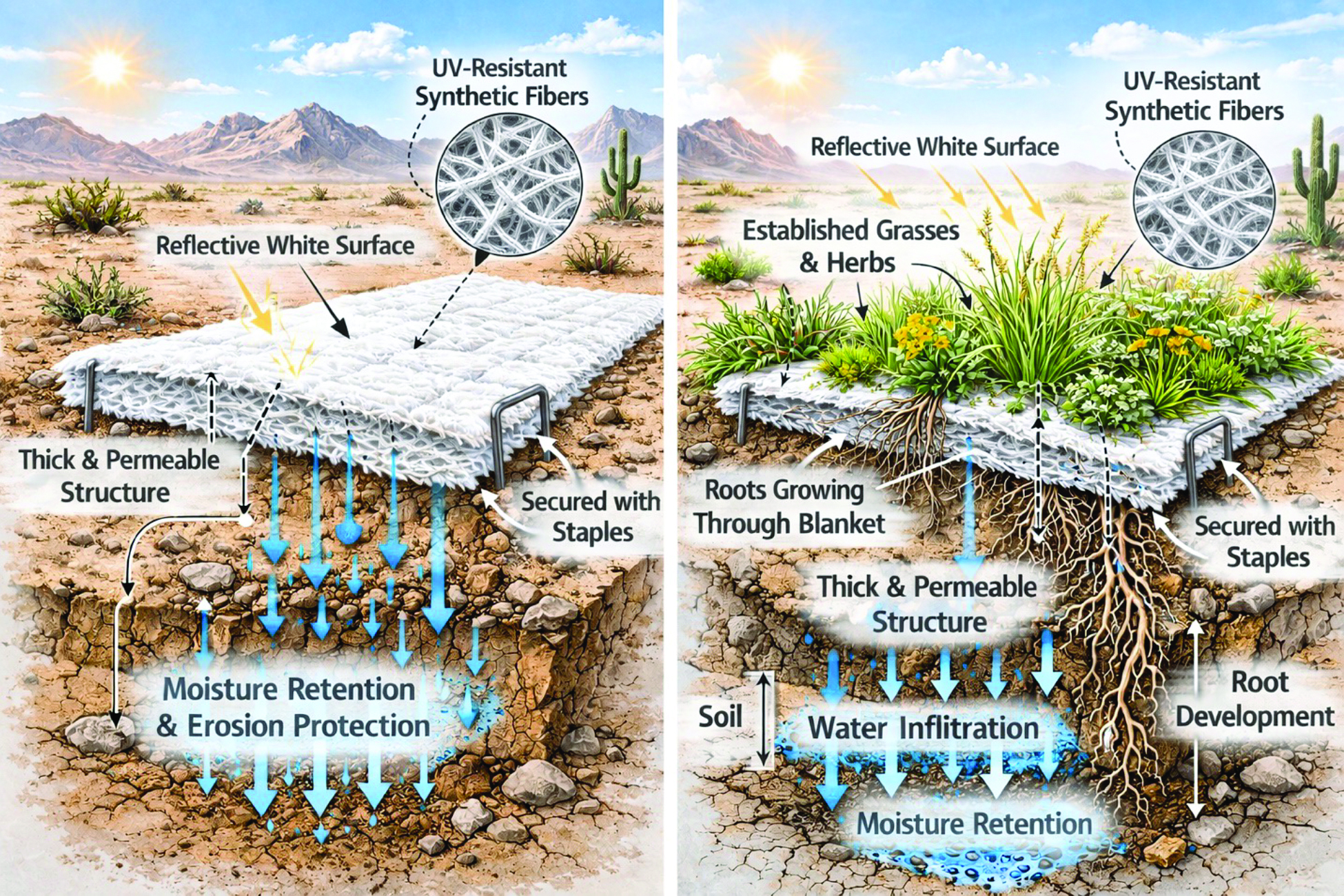
Such a blanket must satisfy several critical performance criteria (Fig. 1). First, it must be fabricated from a highly UV-resistant and mechanically durable material capable of withstanding prolonged solar exposure, large diurnal temperature fluctuations, and strong
wind speeds without polluting the environment. Polymer blends with UV stabilizers or mineral enhanced fibers are preferable to biodegradable mats that photodegrade prematurely.
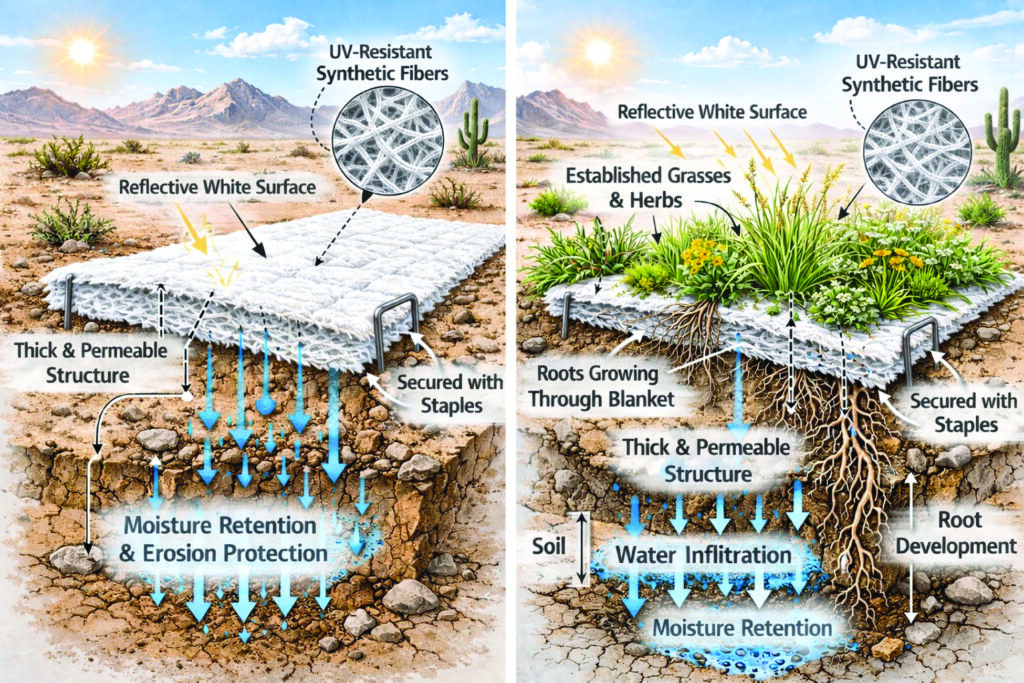
Second, the blanket must offer high and hydraulically balanced permeability to allow infiltration while preventing surface sealing and
underflow erosion. The blanket must have a controlled pore structure of sufficient thickness to attenuate raindrop impact energy, reduce
shear stress at the soil interface, and promote moisture retention for seed germination during the summer months for several years.
Colour and thermal behaviour are also fundamental design variables. A white or high-albedo surface is advantageous in arid climates because it reflects solar radiation, which reduces substrate temperatures, minimizes evaporative losses, and encourages more successful plant establishment. The darker blankets used in other settings can exacerbate soil overheating, inhibit seedling establishment, and accelerate material breakdown.
Blanket thickness is equally important; a robust, lofted structure improves microtopographic roughness, traps sediment, enhances
soil-blanket contact, and creates a favourable microclimate for biological crust recovery or revegetation efforts.
Anchoring and Installation
Beyond material and hydraulic properties, anchoring and installation methodology is a critical but often overlooked component of
performance. In arid environments characterized by shallow, compacted, or skeletal soils, traditional staking systems often fail under
high wind velocities or intense runoff pulses.
A climate-adapted blanket must therefore incorporate reinforced edge treatments, integrated anchoring grids or soil-compatible
fastening systems designed to resist uplift, sliding, and concentrated flow detachment. Proper installation protocols, including
trenching at the crest and toe, overlap design, and wind-oriented deployment are essential to ensure long-term stability and
hydraulic functionality.
Another consideration is the blanket’s long-term durability and service-life predictability. In arid regions, extreme UV radiation, thermal
cycling, and abrasive sediment transport accelerate material fatigue. Therefore, a blanket must be engineered with quantifiable performance metrics such as tensile strength retention under UV exposure, creep resistance under sustained load, and resistance to thermal embrittlement. Standardized laboratory and field testing protocols specific to arid climates would allow engineers and regulators to specify
minimum durability thresholds, ensuring that products remain functional throughout the multiyear periods required for vegetation establishment and geomorphic stabilization.
Cost-effectiveness is essential. Arid regions are often vast, and erosion control projects typically operate under constrained public or
community budgets. A scalable manufacturing process using inexpensive raw materials— potentially recyclable or locally sourced—
would allow broad deployment at sites such as highways, mining reclamation sites, rangelands, and post-fire landscapes.
In terms of the plants to be used, successful arid-land slope stabilization requires species that combine deep and fibrous root architecture,
high drought tolerance, and rapid establishment under episodic moisture availability. Ideal candidates include native perennial bunchgrasses (e.g., Bouteloua, Pleuraphis, Festuca) that develop dense, fibrous root mats for surface soil reinforcement, combined with deep-rooted shrubs such as Atriplex, Larrea, or Artemisia species, which provide vertical anchorage and improve soil structure through rhizosphere development.
Nitrogen-fixing species (e.g., certain Prosopis or Acacia varieties) can enhance soil fertility in nutrient-poor substrates, while pioneer forbs contribute early ground cover to reduce raindrop impact and surface sealing. Preference should be given to native ecotypes that adapt to local precipitation regimes, offer high salinity tolerance when necessary, and withstand extreme thermal amplitudes without causing ecological problems.
Water Retention
Arid and desert soils are characterized by low organic matter content, limited nitrogen and phosphorus availability, weak aggregate
stability, and poor moisture-holding capacity— conditions that constrain plant establishment during slope stabilization efforts. As
a result, the incorporation of water retention polymers and targeted fertilization is a critical design component of a blanket product, not
an optional enhancement.
Superabsorbent polymers can significantly increase the soil’s field capacity by capturing and slowly releasing water during intermittent
rainfall events, extending moisture availability within the root zone and reducing early seedling mortality, mostly for deeper root systems.
When combined with controlled-release fertilizers (preferably formulated with balanced NPK ratios and micronutrients adapted to local deficiencies), plant growth rates, root development, and canopy establishment improve substantially. Amendments must be carefully calibrated to avoid nutrient leaching or osmotic stress in the coarse-textured soils common in arid regions.
Integrating moisture retention with nutrient management enhances revegetation success, accelerates root-mediated soil reinforcement,
and improves the long-term stability and ecological performance of plant-based slope stabilization systems in desert environments.
This approach can be even more successful if combined with rainwater diversion techniques that direct surface runoff to the areas where
new plants will grow.
Regulation and policy must align for a new blanket solution to be successful. Current erosion and sediment control specifications in many jurisdictions are derived from humid-climate performance assumptions, not the geomorphic and climatic realities of arid regions. Updating
technical standards to include climate specific material requirements, albedo criteria, UV resistance benchmarks, and hydraulic performance testing would institutionalize climate-adapted solutions.
Regulatory modernization would not only improve environmental outcomes but also reduce long-term liability exposure for infrastructure
developers and public agencies operating in arid and semi-arid zones. Therefore, what’s needed is not just another erosion blanket, but a climate-adapted, durable, permeable, thick, reflective, and economically accessible solution that’s engineered for the geomorphic realities of arid environments and incorporated into regulatory systems.
About the Expert
Pablo A. Garcia-Chevesich, Ph.D., is a research professor in the Department of Civil and Environmental Engineering of the Colorado
School of Mines in Golden, Colorado, and U.S. ambassador to UNESCO’s Intergovernmental Hydrological Programme.