
Peer Reviewed
Coastal Habitat and Water Quality Initiative is poised to help Marco Island cleanse canals
By Jonathan Koepke
THE COASTAL HABITAT AND Water Quality (C-HAWQ) Initiative is a nonprofit that’s helping Florida’s coastal communities improve water quality and environmental resilience. C-HAWQ advances this work by conducting primary research, promoting public education, and building solutions focused on the waterways, habitats, wildlife, and water quality of coastal communities.
Municipalities throughout Florida can leverage C-HAWQ’s no-cost, noncommercial model to turn dormant water quality projects into shovel-ready initiatives. The initiative supports partners with free advisory services and up to US$250,000 in direct funding, and it can help access sums as large as $100 million in indirect funding through public-private partnerships.
The organization is also a contributor to scientific dialogue, investing more than $1 million in research grants focused on managing human-made waterways and their ecological impacts. As a boots-on-the-ground partner and a scientific contributor, it shares its expertise with that of a growing network of engineers, contractors, and other partners to propose, plan, and deploy site-specific remedies that promote higher ecological function.
Marco Island’s Issues
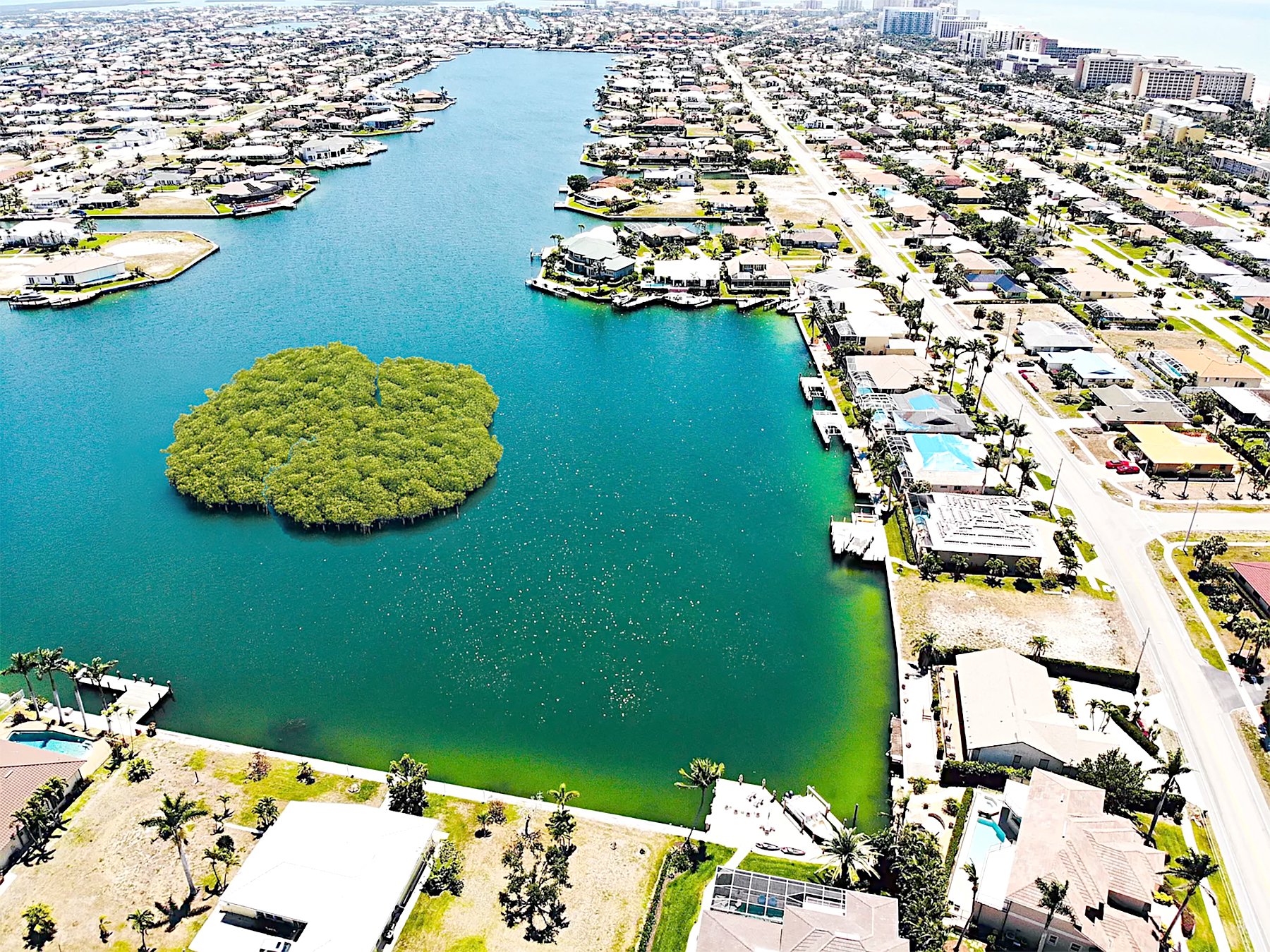
The first project developed by the C-HAWQ team is set to address a water quality issue in Marco Island, Florida. The inland waterways and canals of the small island community extend more than 100 miles, connect its residential communities, and provide direct access to the Gulf of Mexico.
In 2019, the Florida Department of Environmental Protection (FDEP) listed the waterways of Marco Island as “impaired” after logging excessive nitrogen limits in the previous two years. Areas southeast of Marco Island were also listed as impaired for total nitrogen, total phosphorus, and fecal coliform levels.
Some of the activities considered a draw for the island community—boating, fishing, and wildlife-related recreation—are being hindered by the degradation in water quality, and conditions will likely worsen without intervention.
A 2021 water quality report drafted by the water resource engineering firm ERD indicated that the primary sources of nitrogen entering Marco Island’s waterways are sediment release (61%–77% of annual nitrogen loadings) and groundwater seepage (15%–30% of annual nitrogen loadings). In an effort to address these issues, the City of Marco Island sought 4e designation from FDEP, indicating that ongoing restoration activities are in place to remedy water quality issues.
The plan in place outlines a series of mitigation measures recommended by the 2021 ERD report:
- Implementation of stormwater best management practices (BMPs);
- Reclaimed water management/reuse irrigation;
- Circulation improvement to canals;
- Continued water quality monitoring; and
- Septic system management/phase-out.
These initiatives are important steps in reducing point and nonpoint sources of nutrient loading into Marco Island’s waterways. They do not, however, address the primary source of nitrogen and other excess nutrients into the island’s estuarine waterways—sediments that have been building up since the canals’ construction in the 1960s.
Considering the similarly degraded adjacent waters outside of Marco Island’s jurisdiction, maintaining the city’s categorization as having Class II waters sufficient for shellfish propagation and harvesting will require additional measures to meet the stringent water quality standards.
Creating Blue-Green Infrastructure
C-HAWQ proposes to improve the impaired water quality in the canals of the City of Marco Island through the application of nature-based or “blue-green” restoration solutions. Nature-based infrastructure solutions use natural ecological processes to improve water quality rather than solely technological, mechanical, or chemical-based processes.
Research shows that blue-green methods can be reliably effective and provide a variety of benefits while addressing water quality and stormwater management at the lowest overall costs. Blue-green infrastructure solutions are hybrid systems that provide numerous benefits including economic, societal, and environmental improvements around land and watercourses.
The systems take a multidisciplinary approach to addressing complex and interrelated problems, often taking innovative, nontraditional approaches wherever human development interacts with natural areas, waterways, and water bodies. They provide adaptive systems that benefit human well-being and biodiversity alike.
Blue-green infrastructure also incorporates sustainability into design solutions, creating long-lasting and resilient systems that require less long-term maintenance and cost inputs than traditional infrastructure solutions. The blue-green philosophy is a cornerstone of C-HAWQ’s proposal for Marco Island.
Applying Innovative Solutions
C-HAWQ’s plan targets the biggest issues contributing to poor water quality by dredging nutrient-rich sediments and sands from the bottom of the canals and establishing mangrove islands with native vegetation. The ERD report previously recommended dredging and removal of sediments, but that strategy proved too costly to implement.
C-HAWQ proposes to drastically cut costs by dredging the canals using mechanical rather than hydraulic methods and placing the sand and sediment in human-made islands that can be planted with native mangroves, seagrasses, and other native plants. The reuse of dredged sediment and sand to construct mangrove habitat islands eliminates disposal and trucking costs while sequestering excess nutrients and other pollutants.
Each constructed mangrove island is surrounded by limestone—an ideal substrate for oyster colonization, which would provide another level of water purification potential. Oyster reefs improve water quality by filtering algae and excess nutrients; once established, the islands and oyster beds will teem with life, providing improved water quality and critical habitats for fish, birds, and other wildlife valued by the Marco Island community.
The Public-Private Partnership
The C-HAWQ team identified Earthwerks Land Improvement & Development Corp. as a contracting lead that could help bring the City of Marco Island an unsolicited public-private partnership (P3) proposal to implement the project.
C-HAWQ’s no-cost, collaborative planning phase covers visioning, stakeholder engagement, feasibility assessments, and preliminary engineering, allowing projects to move quickly from concept to plan. Once a concept is ready, the initiative supports municipalities in securing at least 50% of project funding from outside sources through P3 structures and philanthropic channels.
Under the Marco Island proposal, Earthwerks serves as the general contractor, entering a comprehensive agreement to shepherd the project from beginning to end. The contractor proposes to provide, at its own risk and expense, lobbying on behalf of the City of Marco Island and applying for grants to secure all necessary funding. Before moving to construction, the company will pursue and complete all necessary engineering and permitting.
Once funding and permitting are complete, Earthwerks will determine the final scope of work and proceed to construction. The estimated construction timeline for Marco Island is two years, plus three to five years of maintenance and monitoring of the artificial island structures to ensure adequate development of the natural habitat.
The total project cost is estimated at $60 million. The City of Marco Island is now in the process of evaluating the proposal for technical merit before moving forward with an exciting and unique water quality improvement project. For updates, visit chawq.org/marco-island.
About the Expert
Jonathan Koepke is president of ENCAP Inc. He has been a stormwater professional for more than 20 years, working with the public and private sectors to construct and implement real-world stormwater BMPs.