A phased approach to reclaim, restore, and re-create the landscape combines precise earthwork, soil rebuilding, and vegetation design to heal a century-old limestone quarry
By Rachel Reynolds, CPESC, CESSWI
ELEVATED ABOVE COLORADO SPRINGS, Pikeview Quarry stands out as a historic landmark. For more than a century, it supplied more than half of the limestone that built the city. From 1903 to 2018, workers carved out the mountainside and left a 125-acre (50.6 ha) gash locals refer to as “The Scar.”
After a series of slope failures forced the mine’s permanent closure, the Colorado Division of Reclamation, Mining, and Safety (DRMS) launched reclamation efforts. The goal? To transform a longstanding industrial landmark into a community asset.
The project would proceed in three phases. First, reclaim the land through grading and stabilization. Next, restore the ecological function of the mountainside through soil and revegetation efforts. And finally, re-create the site as a public area for residents.
The site posed significant environmental and engineering challenges. Not only did workers need to account for high elevations and near-vertical slopes, but a century of mining had left the soil denuded. With careful design and advanced erosion control, however, the project is on the way to reclaiming the large-scale site through data-driven best management practices.
Phase One: Reclamation Through Stabilization
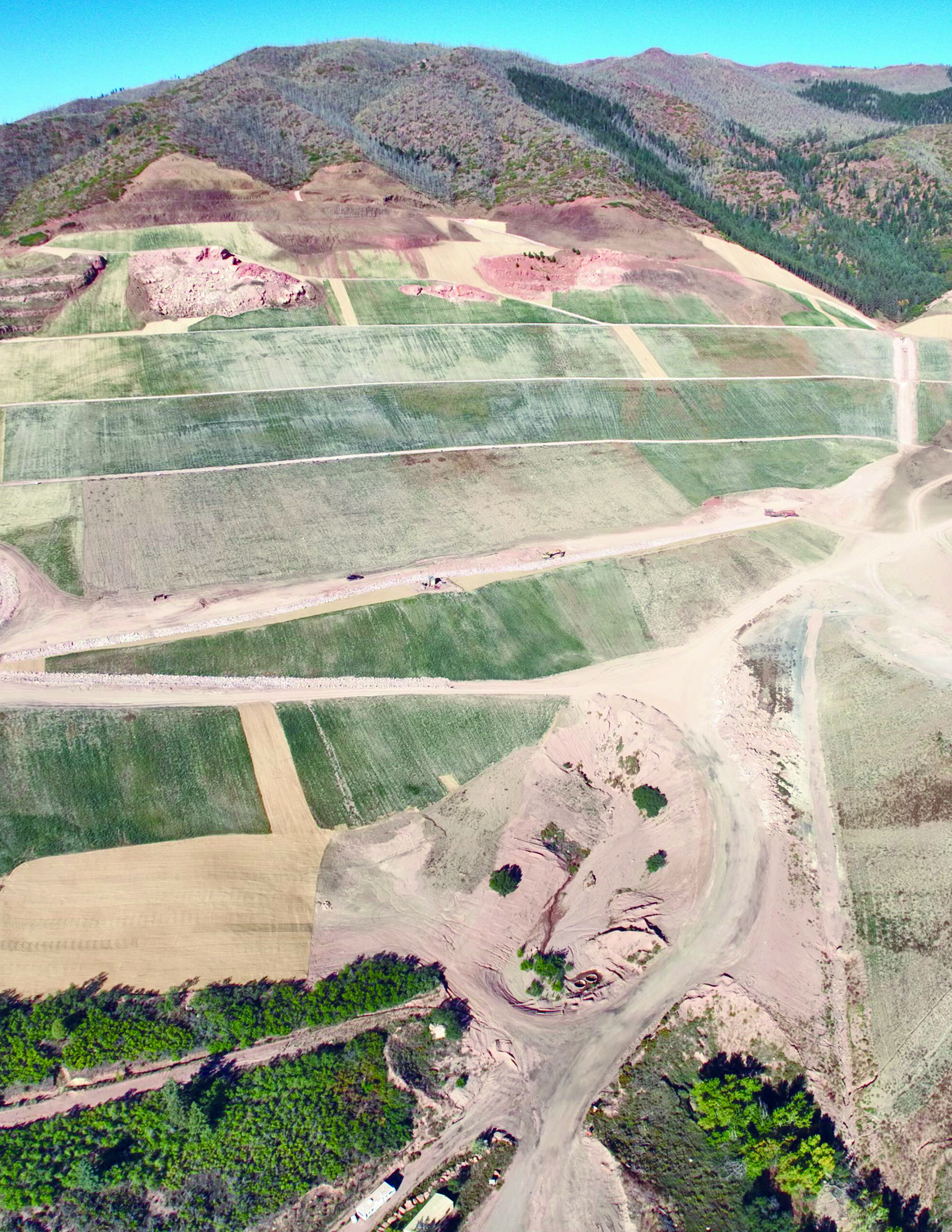
In the first phase of the project, workers needed to regrade the quarry to stabilize the mountainside and prepare the terrain for revegetation. Crews moved approximately 565,000 cubic yards (16,000 m3) of structural material, and earthwork included four miles of channel construction and riprap placement. Once complete, workers had prepared roughly 127 acres (51.4 ha).
Workers opted to drill seed during this stage to maximize seed-to-soil contact. Depending on land ownership, crews applied two different seed mixes: a permanent native mix for erosion control on private surface lands, and a seed mix specified by the U.S. Forest Service (USFS) elsewhere. To accommodate the semi-arid climate, all seed was supplied already coated with endomycorrhiza and ectomycorrhiza fungi, which form symbiotic relationships with plant roots to increase nutrient uptake and water retention. Endomycorrhizae help protect grass seeds, while ectomycorrhizae aid tree development.
Phase Two: Restoration Through Revegetation
The restoration phase focused on revegetation to transform “The Scar” into a lush landscape. Laboratory soil testing provided using Profile’s Soil Solutions Software (PS³) reflected poor conditions, including an average soil pH of 8.2, organic matter content of 0.4%, and high concentrations of soluble salts up to 5.59 dS/m—far from the ideal conditions of 6.3–7.3 pH, organic matter above 5%, and soluble salts less than 0.75 dS/m. The team determined that amending the soil would be essential for successful revegetation.
The quarry’s topography also introduced challenges. While some slopes were on gradual inclines less than 3H:1V, other areas were near-vertical. Recognizing that no single approach would work across the entire site, the team customized erosion control solutions for each section of “The Scar.” Timing was equally unforgiving, with just 10 weeks between grading and the onset of monsoon season to seed the site, apply soil amendments, and install erosion control materials.
Initial specifications called for applying topsoil, but that can bring inconsistent quality, higher costs, and greater labor risks, especially on steep terrain. Workers instead developed a new custom erosion control and revegetation plan that included applying biotic soil technologies—engineered organic growth media designed to revitalize the denuded soil—and a combination of hydraulically applied erosion control products and erosion control blankets to hold seed and soil in place.
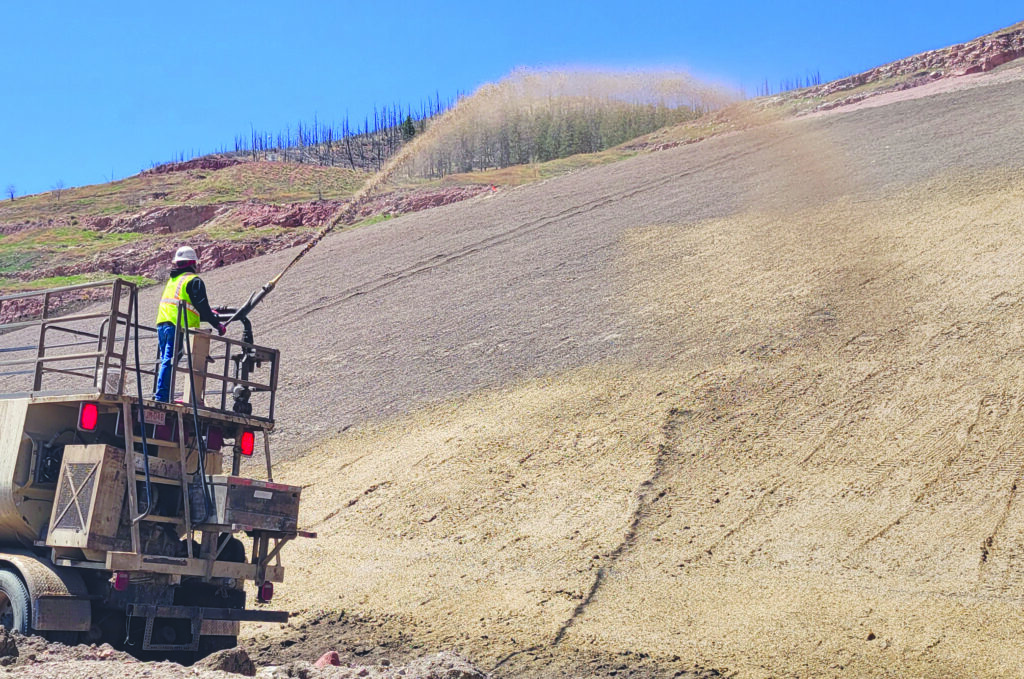
hydraulically applied erosion control products.
For slopes with grades of less than 3H:1V, the contractor applied ProGanics DUAL, an all-in-one soil health and erosion control product. The product spurs the nutrient cycling necessary to improve soil health for sustainable vegetation establishment, while a bonded fiber matrix effectively locks down and protects seed and soil. The one-step, hydraulically applied solution is ideal for such site conditions, especially when application windows are tight. The product was applied at a rate of 5,500 pounds per acre (6,164 kg/ha).
On slopes greater than 3H:1V, the contractor hydraulically applied a biotic soil media from Profile Products to amend the soil blended with FlocLoc polyacrylamide flocculating soil stabilizer, BioSol slow-release fertilizer, humates, and an organic fertilizer at a rate of 3,500 pounds per acre (3,923 kg/ha). Workers then installed a biodegradable, wood-based Excelsior erosion control blanket for additional protection without introducing plastics to the environment.
On the near-vertical slopes, the contractor applied biotic soil media and soil amendments to introduce soil-building components. Workers topped the site with Profile’s ProMatrix EFM—a hydraulically applied erosion control product that provides protection up to a bonded fiber matrix—at 3,500 pounds per acre (3,923 kg/ha).
Within a few weeks of application and aided by late-summer monsoon rains, vegetative growth started to turn the once-barren site green and wildlife returned to the area. The combination of carefully selected seed mixes, soil amendments, and coordinated erosion control solutions brought life back to the slopes. “The Scar” was healing.
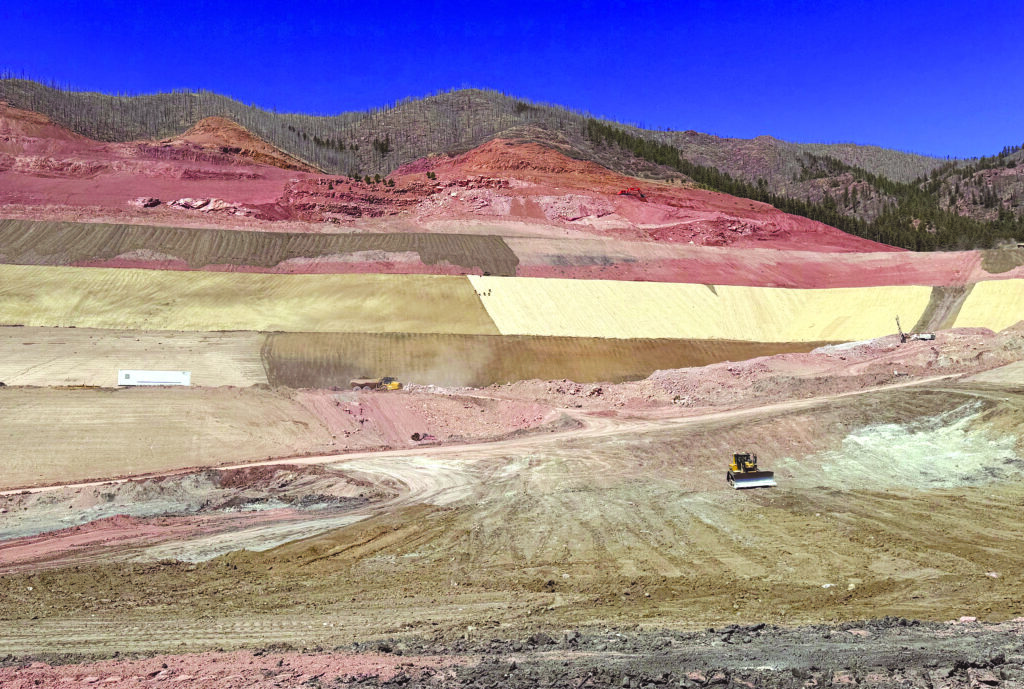
hydraulically applied erosion control products.

Phase Three: Re-Create for Future Use
Once DRMS confirms the successful establishment of vegetation and slope stability after two years of sustained vegetative growth, it will release the site from active mining permits. Castle Aggregates will transfer the property to the City of Colorado Springs, which plans to develop a mountain bike and recreation park overlooking the city. Now—more than a year after application—the site has continued to support vegetation and is on its way to being released.
The project demonstrates that large-scale reclamation is possible through prescriptive, innovative, and collaborative solutions. What was once an environmental blemish is now experiencing rebirth and growth. With integrated erosion control systems and vision, even the most daunting mine reclamation sites can be brought back to life.
About the Expert
Rachel Reynolds, CPESC, CESSWI, is regional business manager for Profile Products. She can be reached at rreynolds@profileproducts.com.