
Practical strategies for pursuing projects that carry defined flood risk
WITH DEVELOPABLE LAND IN short supply, more developers and engineers are eyeing parcels on the edge of mapped floodplains. These sites often look promising—they are close to infrastructure, near growth corridors, and seemingly outside the most restrictive floodway zones.
However, such parcels carry some of the highest entitlement and construction risks, especially when FEMA floodplain reclamation is part of the equation. After two decades collaborating with real estate developers, civil engineers, contractors, and floodplain administrators, one lesson stands out: Success hinges not on complex modeling, but on early, informed decisions and a respect for how water moves through a site.
Say you’ve found a parcel with FEMA floodplain designation and are considering reclaiming some of it for development or resale, or perhaps you’re representing a client with similar ambitions. The first question is always, “How much can I reclaim?” The answer: It depends. Here are eight things you need to consider before moving forward.
1. Flood Risk Is More Than a Map
A mapped floodplain signals real flood risk. Just because a site hasn’t flooded recently—or ever—doesn’t mean it won’t. The “1% annual chance floodplain” (often called the 100-year floodplain) means there’s a 1% chance a flood will reach that level each year. It could happen multiple times a year, or not at all for decades. For design professionals, this designation provides a minimum baseline for setting habitable structure elevations and ensuring safety.
2. Decoding FEMA Zone Designations
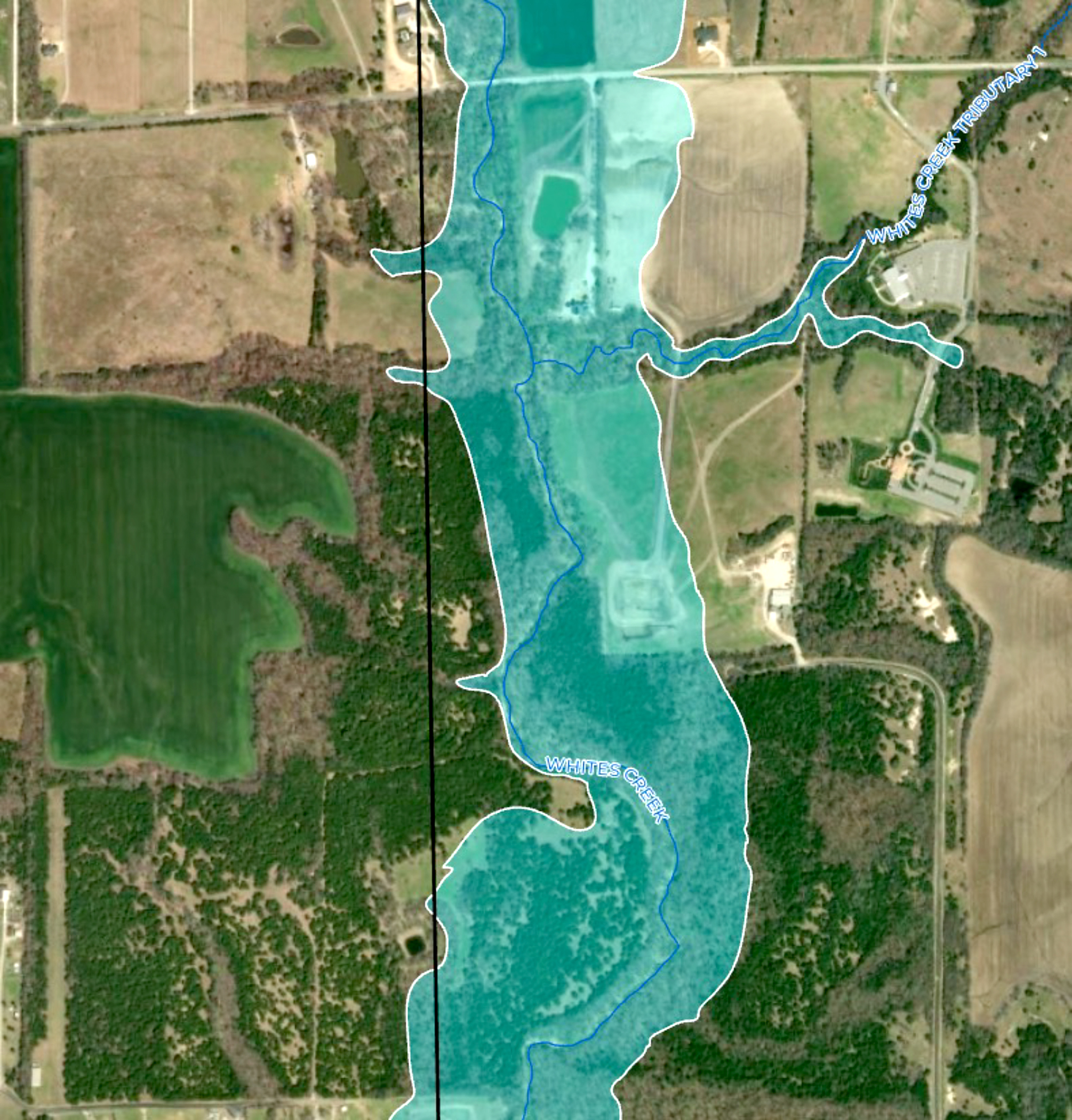
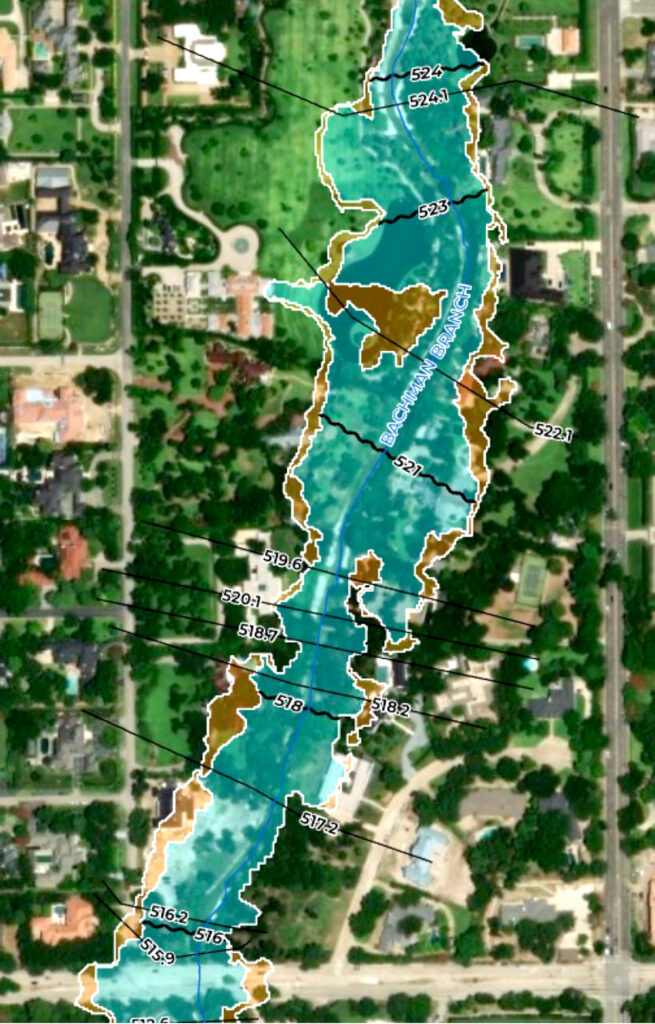
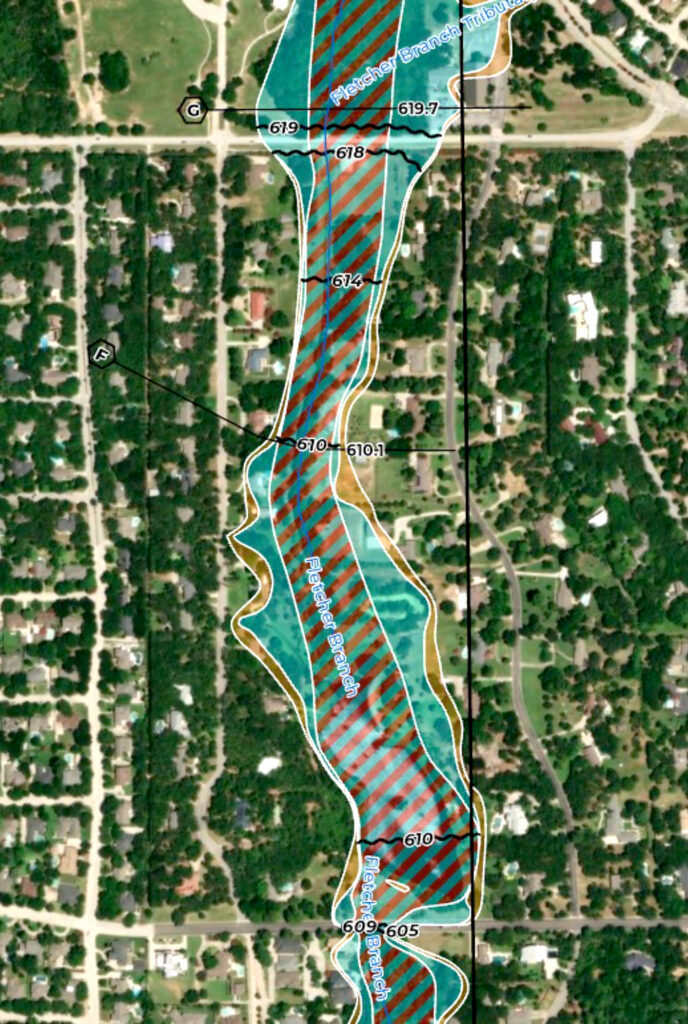
FEMA’s alphabet soup of zones—A, AE, A1-30, AH, AO, A99, V, VE, V1-30—can be confusing. On most projects, you’ll see Zones A and AE (Figs. 1–3). Zone A is often mapped with limited data and may lack defined flood elevations, making it unreliable for precise design. By contrast, Zone AE streams are studied in detail, with hydrology and hydraulic (H&H) models supporting the mapped risk, base flood elevations, and sometimes a defined floodway. Knowing your site’s designation is essential for responsible planning.
You should also know what level of development the site had when the study was done. Some municipalities require even detailed studies to be redone assuming full development based on zoning or planning, which can increase final water surface elevation significantly.
3. Local Standards Set the Bar High
FEMA requires mitigation for any adverse impact to water surface elevations, but many localities go beyond these mandates. You may need to evaluate channel velocities, stream erosion potential, valley storage, and equal conveyance. Some jurisdictions require analysis of a fully developed watershed, which can reveal more restrictive floodplain boundaries than FEMA’s maps might suggest. Identify these requirements early to avoid costly redesigns and lost development potential.
4. Plan for the Long Haul in Permitting and Coordination
Coordinating with FEMA is a process, not a checklist. Before engaging FEMA, your design must meet all local standards, which can take many months. If a Conditional Letter of Map Revision (CLOMR) or Letter of Map Revision (LOMR) is required, expect the timeline to stretch into years. Depending on the floodplain being reclaimed, the project may also need to secure U.S. Army Corps of Engineers permits, which can also take years to obtain and close out.
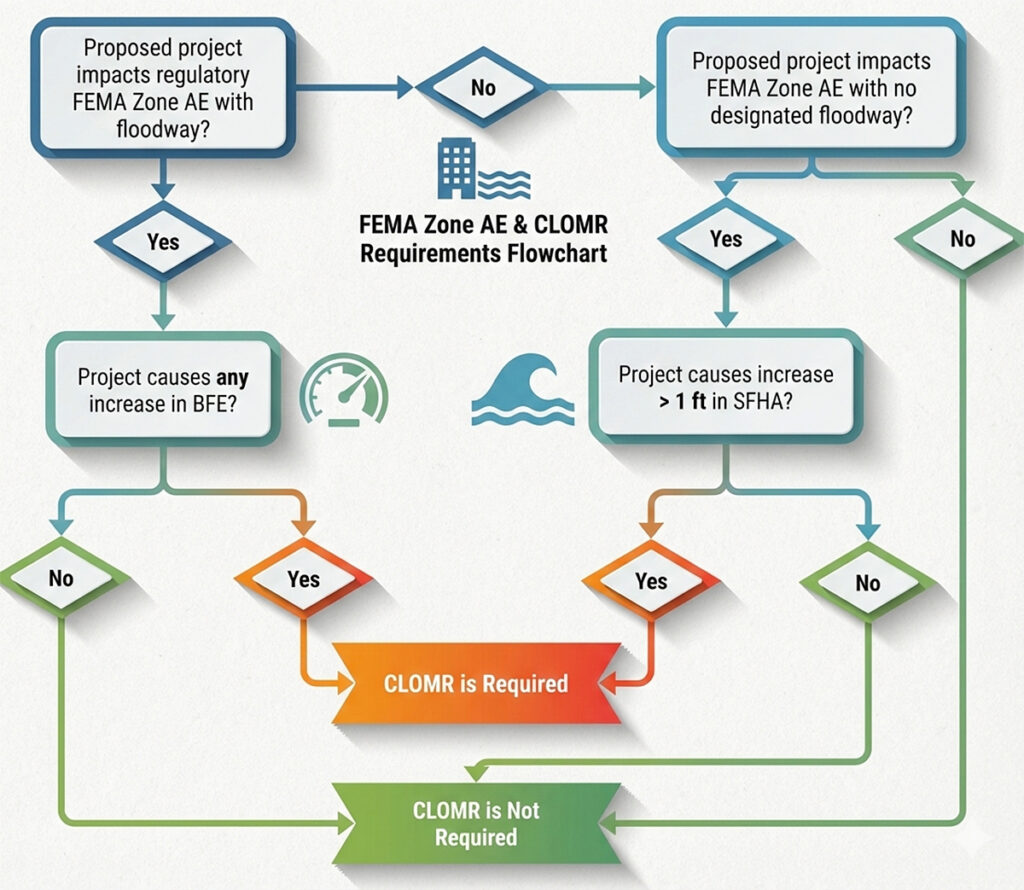
CLOMRs are required by FEMA in certain instances (Fig. 4), but are otherwise considered optional and up to the local floodplain administrator. They may take up to a year to coordinate through FEMA before issuing local permits, and after construction, the LOMR process with FEMA can add another 12–15 months before the flood map is officially updated. Factor this into your project strategy from the outset.
5. Cut and Fill Goes Beyond Volume Balance
Floodplain reclamation isn’t just a numbers game. While balancing cut and fill volumes looks simple on paper, real-world conditions complicate matters. Cuts and fills should occur within the same hydraulic reach to ensure flood storage is replaced where it functions. Excavated areas must connect hydraulically and activate during flood events, not become isolated depressions. Compaction requirements are stricter, construction sequencing is more limited, and erosion and maintenance risks are higher. A practical tip: Overexcavate compensatory storage slightly to account for future sedimentation and vegetation growth.
6. Let Water Do What It Does Best
Equal conveyance means preserving the natural flow of water through your site. Problems arise when flow paths are blocked by building pads, roads, or fills that prioritize convenience over hydraulics. These issues may not show up in minor storms, but they may become critical during major flood events. Successful designs maintain predevelopment flow paths and account for both minor and base flood conditions.
Pay special attention to transitions between channels and floodplain areas, where velocities and water surface elevations can change rapidly. In modeling, clear and logically spaced cross-sections that reflect actual site conditions are more effective than overly complex models.
7. Velocity and Stabilization: Protect Your Investment
Even with proper floodplain storage and conveyance, unmanaged changes in water velocity can undermine a project. Localized velocity increases often occur near culvert outlets, channel realignments, floodplain tie-ins, and roadway crossings. Stabilization measures should match the hydraulic demands of each location; overarmoring increases costs and maintenance, while understabilizing invites erosion and regulatory headaches. The best solutions combine targeted hard armor where needed with soil stabilization, revegetation, and grade control elsewhere, always considering long-term maintenance.
8. The Most Defensible Designs Win
FEMA reviewers and local floodplain administrators aren’t looking for clever solutions; they want defensible ones. Successful submittals include clear before-and-after exhibits; transparent volume and conveyance accounting; and consistent assumptions across models, drawings, and narratives. Designs that are simple to explain and logically structured are more likely to move smoothly through review. Conservative assumptions and thorough documentation can reduce review cycles and shorten approval timelines.
Developing land near a floodplain is more than meeting minimum regulatory criteria. It requires stewardship, resilience, and protecting your project and the surrounding community. Integrate hydrology and hydraulic considerations early, and FEMA floodplain reclamation can unlock land value responsibly and efficiently. Treat floodplain issues as an afterthought, and they will become sources of cost, delay, and frustration. For developers and engineers, the path to success is paved with informed decisions, practical strategies, and respect for the dynamic systems at play.
About the Expert
Thomas Caffarel, PE, CFM, is principal and head of engineering at Cardinal Strategies LLC, a global stormwater compliance management firm based in Wylie, Texas.