
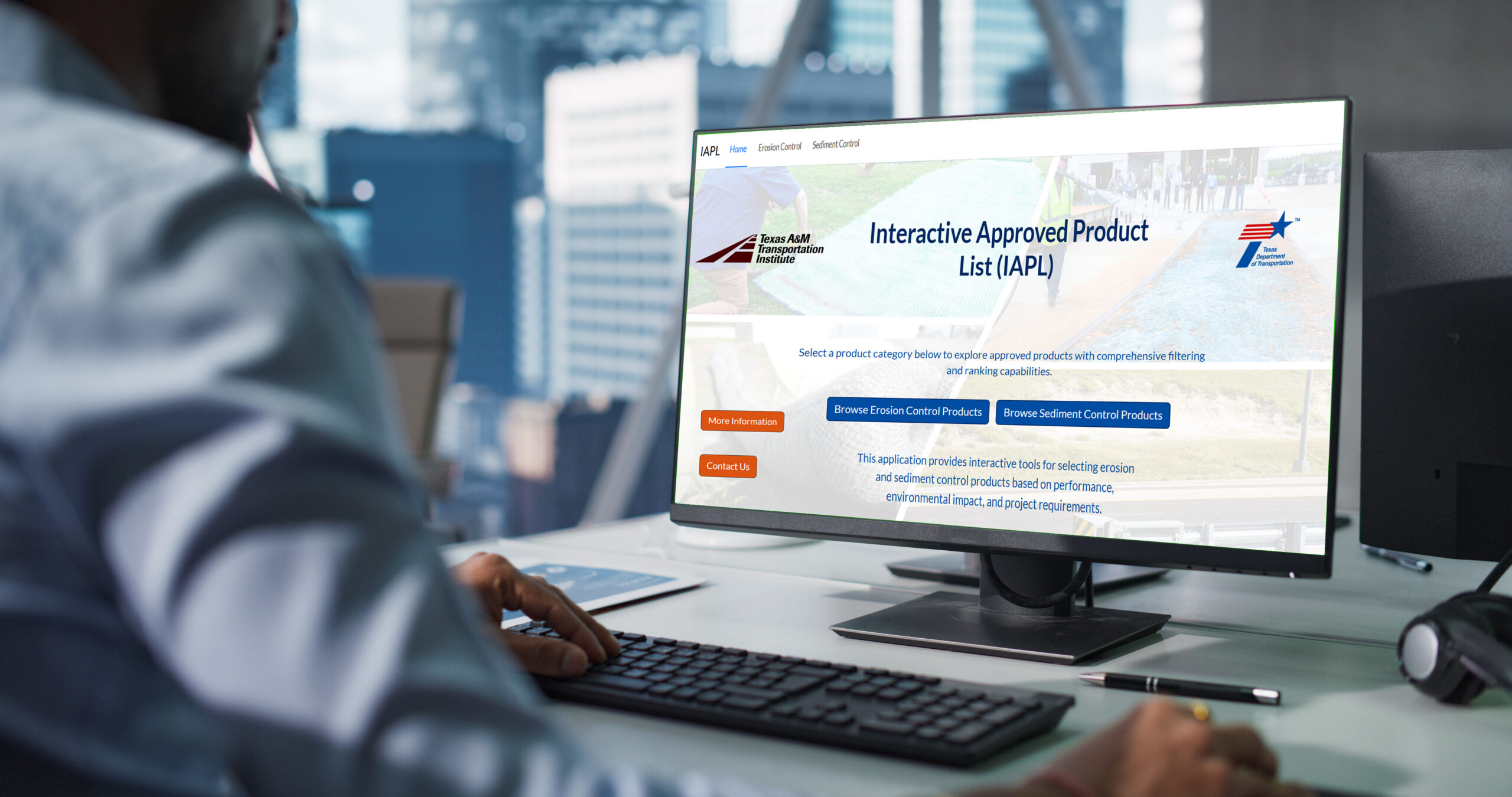
Texas DOT’s enhanced Interactive Approved Product List takes the guesswork out of specification
IN THE 1980S, THE Texas Department of Transportation (TxDOT) didn’t have a consistent, statewide evaluation program for erosion control products. Only two products met the standard specifications for erosion control blankets, and others were excluded from bids due to material-based requirements. To address these limitations, the agency explored alternatives that would establish a fair, performance-based system for selecting and specifying erosion control products.
In 1993, TxDOT transitioned from material specifications to performance-based standards. The shift marked the beginning of a formal performance testing program, implemented through an interagency contract between the State of Texas and the Texas A&M Transportation Institute (TTI) Sediment & Erosion Control (SEC) Laboratory.
Products approved for use by TxDOT were evaluated at the TTI SEC Lab and confirmed to meet TxDOT soil-loss thresholds and vegetation establishment requirements before being placed on the TxDOT Approved Products List (APL).
Starting in the mid-1990s, the APL existed as a static document, hosted online but updated only when products passed TxDOT thresholds. Listings were organized alphabetically and by basic filters such as slope and soil type, which often required end users to conduct additional research to obtain detailed product information. Furthermore, users couldn’t compare performance data from TTI’s SEC Lab evaluations, limiting the list’s utility.
To address these limitations, TTI launched the Interactive Approved Products List (IAPL) in 2021. The interactive, web-based tool identifies products approved for TxDOT use and enables designers, engineers, and other stakeholders to filter selections based on site-specific conditions. Initially developed in Tableau—a platform designed for visual analytics—the IAPL quickly grew in complexity. More products and filtering capabilities were added, and a need emerged for a more robust, scalable solution.
A New Database Debuts
In 2025, ITT rebuilt the IAPL completely using the Shiny for Python application to offer enhanced flexibility, efficiency, and creative functionality. The updated platform offers faster performance, mobile-friendly access, real-time updates, and an intuitive user interface designed for ease of use in field and office environments—wherever the selection of appropriate erosion and sediment control products is needed.
Key filtering capabilities include:
- Product application. The IAPL’s first filter allows the end user to sort by the two main erosion control product applications: slope or channel protection.
- Product type. This filter sorts for hydraulic erosion control products (HECPs), rolled erosion control products (RECPs), and hydromulch for seeding, aligning with corresponding TxDOT standard specification item numbers.
- Slope and soil type. An end user can specify site conditions such as slope ratios (e.g., 2:1, 3:1, 4:1) and soil classifications (clay, sand).
- Desired longevity. Based on definitions provided by the Erosion Control Technology Council, an end user can sort products that meet specific longevity requirements—for example, up to 12 months.
- Shear stress. When selecting a channel erosion control product, the end user can filter for products approved under specific shear stress conditions, ranging from 2 pounds per ft2 (95.76 pascals) to 8 pounds per ft2 (383.04 pascals), ensuring suitability for anticipated hydrology.
- Wildlife-friendly options. If a design engineer needs to meet certain wildlife standards, users can select products that minimize wildlife entrapment risks according to the U.S. Fish & Wildlife Service.
The IAPL’s data architecture was also modernized in 2025 using the Flask framework for Python, which facilitates immediate publication of new product approvals and streamlined coordination between TTI and manufacturers. This upgrade improves data organization and facilitates updates on product photos, web links, and name changes, saving time and reducing administrative burdens.
TTI is now collaborating with TxDOT to expand the IAPL to include sediment control products. Current research focuses on establishing performance thresholds for these products, which are evaluated for parameters such as change in flow rate, turbidity, and total suspended solids. Categories tested at the TTI SEC Lab include Concrete Approach Drop Inlet, Curb Inlet Protection, Perimeter Protection/In-Stream, and Soil Approach Drop Inlet. The TTI SEC Lab can also test dewatering bags and turbidity curtains, which may be added to the IAPL in the future.
Silt fences approved by TxDOT will soon be included on the IAPL, though TxDOT approves silt fences based on material rather than performance specifications. A dedicated sediment control tab is available on the IAPL for users to reference what products have already been tested.
Although developed for TxDOT’s APL, the IAPL website is publicly accessible and a valuable resource for private-sector engineers, contractors, and designers seeking performance-based product information. While the IAPL reflects TxDOT standards, users should be aware that other states
may maintain their own approved product lists with different performance criteria
and specifications.
Access the TxDOT IAPL here: iapl.tti.tamu.edu/iapl.
About the Experts
Joshua Bell is a research specialist II at TTI’s Sediment and Erosion Control Lab. He has expertise in water quality, vegetation establishment, and product performance testing.
Jett McFalls is a research scientist at TTI’s Sediment and Erosion Control Lab. He has led numerous vegetation and water quality studies as principal investigator and has served actively on IECA subcommittees since joining the association in 1990.